Introduction: Not all queries are equal—some need fast, cheap responses while others require deep reasoning. Query routing intelligently directs requests to the right model, index, or processing pipeline based on query characteristics. Route simple factual questions to smaller models, complex reasoning to GPT-4, and domain-specific queries to specialized indexes. This approach optimizes both cost and quality: you’re not paying for GPT-4 to answer “what time is it?” while ensuring complex queries get the reasoning power they need. This guide covers practical routing strategies: intent classification, semantic routing, complexity-based model selection, and multi-index retrieval routing. Whether you’re building a cost-efficient chatbot or a sophisticated RAG system, intelligent routing can reduce costs by 60-80% while maintaining or improving response quality.
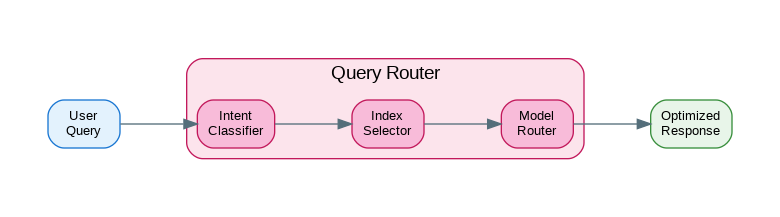
Intent-Based Routing
from dataclasses import dataclass, field
from typing import Any, Optional, Callable
from abc import ABC, abstractmethod
from enum import Enum

class QueryIntent(Enum):
    """Query intent categories."""

    FACTUAL = "factual"           # Simple fact lookup
    ANALYTICAL = "analytical"      # Requires reasoning
    CREATIVE = "creative"          # Creative writing
    CODE = "code"                  # Code generation
    CONVERSATIONAL = "conversational"  # Chitchat
    SEARCH = "search"              # Information retrieval
    TASK = "task"                  # Action/task execution

@dataclass
class RoutingDecision:
    """Routing decision."""

    intent: QueryIntent
    model: str
    index: str = None
    confidence: float = 1.0
    metadata: dict = field(default_factory=dict)

class IntentClassifier(ABC):
    """Abstract intent classifier."""

    @abstractmethod
    async def classify(self, query: str) -> tuple[QueryIntent, float]:
        """Classify query intent."""
        pass

class KeywordIntentClassifier(IntentClassifier):
    """Rule-based intent classification."""

    def __init__(self):
        self.patterns = {
            QueryIntent.CODE: [
                "write code", "implement", "function", "class",
                "debug", "fix this code", "python", "javascript"
            ],
            QueryIntent.FACTUAL: [
                "what is", "who is", "when did", "where is",
                "how many", "define", "what does"
            ],
            QueryIntent.ANALYTICAL: [
                "why", "explain", "analyze", "compare",
                "what are the implications", "how does this affect"
            ],
            QueryIntent.CREATIVE: [
                "write a story", "create", "imagine",
                "generate ideas", "brainstorm"
            ],
            QueryIntent.CONVERSATIONAL: [
                "hello", "hi", "how are you", "thanks",
                "bye", "good morning"
            ],
            QueryIntent.SEARCH: [
                "find", "search", "look up", "show me",
                "list", "what are some"
            ],
            QueryIntent.TASK: [
                "schedule", "remind", "send", "book",
                "order", "calculate"
            ]
        }

    async def classify(self, query: str) -> tuple[QueryIntent, float]:
        """Classify using keyword matching."""

        query_lower = query.lower()

        scores = {}
        for intent, keywords in self.patterns.items():
            score = sum(1 for kw in keywords if kw in query_lower)
            if score > 0:
                scores[intent] = score

        if not scores:
            return QueryIntent.CONVERSATIONAL, 0.5

        best_intent = max(scores, key=scores.get)
        confidence = min(scores[best_intent] / 3, 1.0)

        return best_intent, confidence

class LLMIntentClassifier(IntentClassifier):
    """LLM-based intent classification."""

    def __init__(self, llm_client: Any):
        self.llm = llm_client

        self.prompt_template = """Classify the following query into one of these categories:
- FACTUAL: Simple fact lookup or definition
- ANALYTICAL: Requires reasoning, analysis, or explanation
- CREATIVE: Creative writing or idea generation
- CODE: Code generation, debugging, or programming help
- CONVERSATIONAL: Casual conversation or greetings
- SEARCH: Information retrieval or listing
- TASK: Action execution or task completion

Query: {query}

Respond with just the category name and confidence (0-1):
Category:
Confidence: """

    async def classify(self, query: str) -> tuple[QueryIntent, float]:
        """Classify using LLM."""

        prompt = self.prompt_template.format(query=query)
        response = await self.llm.complete(prompt)

        # Parse response
        lines = response.content.strip().split('\n')

        category = "CONVERSATIONAL"
        confidence = 0.5

        for line in lines:
            if line.startswith("Category:"):
                category = line.split(":")[1].strip().upper()
            elif line.startswith("Confidence:"):
                try:
                    confidence = float(line.split(":")[1].strip())
                except ValueError:
                    pass

        try:
            intent = QueryIntent[category]
        except KeyError:
            intent = QueryIntent.CONVERSATIONAL

        return intent, confidence

class EmbeddingIntentClassifier(IntentClassifier):
    """Embedding-based intent classification."""

    def __init__(
        self,
        embedding_model: Any,
        examples: dict[QueryIntent, list[str]]
    ):
        self.embedding_model = embedding_model
        self.examples = examples
        self.intent_embeddings: dict[QueryIntent, list] = {}

    async def initialize(self):
        """Pre-compute example embeddings."""

        for intent, queries in self.examples.items():
            embeddings = await self.embedding_model.embed(queries)
            self.intent_embeddings[intent] = embeddings

    async def classify(self, query: str) -> tuple[QueryIntent, float]:
        """Classify using embedding similarity."""

        import numpy as np

        query_embedding = await self.embedding_model.embed([query])
        query_embedding = np.array(query_embedding[0])

        best_intent = QueryIntent.CONVERSATIONAL
        best_score = -1

        for intent, embeddings in self.intent_embeddings.items():
            embeddings_array = np.array(embeddings)

            # Compute similarities
            similarities = np.dot(embeddings_array, query_embedding) / (
                np.linalg.norm(embeddings_array, axis=1) * np.linalg.norm(query_embedding)
            )

            # Use max similarity
            max_sim = np.max(similarities)

            if max_sim > best_score:
                best_score = max_sim
                best_intent = intent

        return best_intent, float(best_score)
Model Routing
from dataclasses import dataclass
from typing import Any, Optional
from enum import Enum

class ModelTier(Enum):
    """Model tiers by capability/cost."""

    FAST = "fast"      # GPT-3.5, Claude Instant
    BALANCED = "balanced"  # GPT-4-turbo, Claude 3 Sonnet
    POWERFUL = "powerful"  # GPT-4, Claude 3 Opus

@dataclass
class ModelConfig:
    """Model configuration."""

    name: str
    tier: ModelTier
    cost_per_1k_tokens: float
    max_tokens: int
    supports_functions: bool = True
    supports_vision: bool = False

class ModelRouter:
    """Route queries to appropriate models."""

    def __init__(self):
        self.models = {
            ModelTier.FAST: ModelConfig(
                name="gpt-3.5-turbo",
                tier=ModelTier.FAST,
                cost_per_1k_tokens=0.0015,
                max_tokens=16384
            ),
            ModelTier.BALANCED: ModelConfig(
                name="gpt-4-turbo",
                tier=ModelTier.BALANCED,
                cost_per_1k_tokens=0.01,
                max_tokens=128000
            ),
            ModelTier.POWERFUL: ModelConfig(
                name="gpt-4",
                tier=ModelTier.POWERFUL,
                cost_per_1k_tokens=0.03,
                max_tokens=8192
            )
        }

        # Intent to tier mapping
        self.intent_tiers = {
            QueryIntent.FACTUAL: ModelTier.FAST,
            QueryIntent.CONVERSATIONAL: ModelTier.FAST,
            QueryIntent.SEARCH: ModelTier.FAST,
            QueryIntent.TASK: ModelTier.BALANCED,
            QueryIntent.CODE: ModelTier.BALANCED,
            QueryIntent.ANALYTICAL: ModelTier.POWERFUL,
            QueryIntent.CREATIVE: ModelTier.BALANCED
        }

    def route(
        self,
        intent: QueryIntent,
        query_length: int = 0,
        require_functions: bool = False,
        require_vision: bool = False
    ) -> ModelConfig:
        """Route to appropriate model."""

        # Get base tier from intent
        tier = self.intent_tiers.get(intent, ModelTier.BALANCED)

        # Upgrade tier if query is complex (long)
        if query_length > 2000 and tier == ModelTier.FAST:
            tier = ModelTier.BALANCED

        # Get model config
        model = self.models[tier]

        # Check requirements
        if require_functions and not model.supports_functions:
            # Upgrade to model with function support
            for upgrade_tier in [ModelTier.BALANCED, ModelTier.POWERFUL]:
                if self.models[upgrade_tier].supports_functions:
                    model = self.models[upgrade_tier]
                    break

        if require_vision and not model.supports_vision:
            # Use vision-capable model
            model = ModelConfig(
                name="gpt-4-vision-preview",
                tier=ModelTier.POWERFUL,
                cost_per_1k_tokens=0.03,
                max_tokens=128000,
                supports_vision=True
            )

        return model

class ComplexityRouter:
    """Route based on query complexity."""

    def __init__(self, llm_client: Any = None):
        self.llm = llm_client

        self.complexity_prompt = """Rate the complexity of answering this query on a scale of 1-10:
1-3: Simple factual lookup or basic task
4-6: Moderate reasoning or multi-step task
7-10: Complex analysis, creative work, or expert knowledge

Query: {query}

Respond with just the number:"""

    async def estimate_complexity(self, query: str) -> int:
        """Estimate query complexity."""

        # Quick heuristics first
        complexity = 3

        # Length-based
        if len(query) > 500:
            complexity += 2
        elif len(query) > 200:
            complexity += 1

        # Keyword-based
        complex_keywords = [
            "analyze", "compare", "explain why", "implications",
            "trade-offs", "optimize", "design", "architect"
        ]

        for keyword in complex_keywords:
            if keyword in query.lower():
                complexity += 1

        # Question count
        question_count = query.count("?")
        complexity += min(question_count - 1, 2)

        # Cap at 10
        complexity = min(complexity, 10)

        # Use LLM for borderline cases
        if self.llm and 4 <= complexity <= 6:
            prompt = self.complexity_prompt.format(query=query)
            response = await self.llm.complete(prompt)

            try:
                llm_complexity = int(response.content.strip())
                complexity = (complexity + llm_complexity) // 2
            except ValueError:
                pass

        return complexity

    async def route(self, query: str) -> ModelTier:
        """Route based on complexity."""

        complexity = await self.estimate_complexity(query)

        if complexity <= 3:
            return ModelTier.FAST
        elif complexity <= 6:
            return ModelTier.BALANCED
        else:
            return ModelTier.POWERFUL

class CostAwareRouter:
    """Route with cost optimization."""

    def __init__(
        self,
        budget_per_request: float = 0.01,
        daily_budget: float = 100.0
    ):
        self.budget_per_request = budget_per_request
        self.daily_budget = daily_budget
        self.daily_spent = 0.0
        self.last_reset = None

        self.model_router = ModelRouter()

    def _estimate_cost(
        self,
        model: ModelConfig,
        input_tokens: int,
        output_tokens: int
    ) -> float:
        """Estimate request cost."""

        total_tokens = input_tokens + output_tokens
        return (total_tokens / 1000) * model.cost_per_1k_tokens

    async def route(
        self,
        intent: QueryIntent,
        query: str,
        expected_output_tokens: int = 500
    ) -> ModelConfig:
        """Route with cost awareness."""

        import datetime

        # Reset daily budget
        today = datetime.date.today()
        if self.last_reset != today:
            self.daily_spent = 0.0
            self.last_reset = today

        # Get ideal model
        ideal_model = self.model_router.route(intent, len(query))

        # Estimate cost
        input_tokens = len(query) // 4
        estimated_cost = self._estimate_cost(
            ideal_model,
            input_tokens,
            expected_output_tokens
        )

        # Check budgets
        if estimated_cost > self.budget_per_request:
            # Downgrade model
            for tier in [ModelTier.BALANCED, ModelTier.FAST]:
                downgraded = self.model_router.models[tier]
                cost = self._estimate_cost(
                    downgraded,
                    input_tokens,
                    expected_output_tokens
                )
                if cost <= self.budget_per_request:
                    return downgraded

        if self.daily_spent + estimated_cost > self.daily_budget:
            # Force cheapest model
            return self.model_router.models[ModelTier.FAST]

        self.daily_spent += estimated_cost
        return ideal_model
Index Routing
from dataclasses import dataclass
from typing import Any, Optional

@dataclass
class IndexConfig:
    """Index configuration."""

    name: str
    description: str
    domains: list[str]
    embedding_model: str
    chunk_size: int

class SemanticIndexRouter:
    """Route queries to appropriate indexes."""

    def __init__(
        self,
        embedding_model: Any,
        indexes: list[IndexConfig]
    ):
        self.embedding_model = embedding_model
        self.indexes = {idx.name: idx for idx in indexes}
        self.index_embeddings: dict[str, list] = {}

    async def initialize(self):
        """Pre-compute index description embeddings."""

        for name, config in self.indexes.items():
            # Embed description and domain keywords
            texts = [config.description] + config.domains
            embeddings = await self.embedding_model.embed(texts)
            self.index_embeddings[name] = embeddings

    async def route(
        self,
        query: str,
        top_k: int = 1
    ) -> list[tuple[str, float]]:
        """Route query to best indexes."""

        import numpy as np

        query_embedding = await self.embedding_model.embed([query])
        query_embedding = np.array(query_embedding[0])

        scores = []

        for name, embeddings in self.index_embeddings.items():
            embeddings_array = np.array(embeddings)

            similarities = np.dot(embeddings_array, query_embedding) / (
                np.linalg.norm(embeddings_array, axis=1) * np.linalg.norm(query_embedding)
            )

            # Use max similarity across description and domains
            max_sim = np.max(similarities)
            scores.append((name, float(max_sim)))

        # Sort by score
        scores.sort(key=lambda x: x[1], reverse=True)

        return scores[:top_k]

class LLMIndexRouter:
    """Use LLM to route to indexes."""

    def __init__(
        self,
        llm_client: Any,
        indexes: list[IndexConfig]
    ):
        self.llm = llm_client
        self.indexes = indexes

        # Build index descriptions
        self.index_descriptions = "\n".join(
            f"- {idx.name}: {idx.description}"
            for idx in indexes
        )

        self.prompt_template = """Given these available knowledge indexes:
{indexes}

Which index(es) should be searched to answer this query?

Query: {query}

Respond with the index name(s), one per line. If multiple indexes are relevant, list them in order of relevance."""

    async def route(
        self,
        query: str,
        top_k: int = 2
    ) -> list[str]:
        """Route using LLM."""

        prompt = self.prompt_template.format(
            indexes=self.index_descriptions,
            query=query
        )

        response = await self.llm.complete(prompt)

        # Parse response
        lines = response.content.strip().split('\n')

        selected = []
        index_names = {idx.name.lower(): idx.name for idx in self.indexes}

        for line in lines:
            line = line.strip().lower()
            # Remove common prefixes
            for prefix in ['- ', '* ', '1. ', '2. ', '3. ']:
                if line.startswith(prefix):
                    line = line[len(prefix):]

            if line in index_names:
                selected.append(index_names[line])

        return selected[:top_k]

class HybridIndexRouter:
    """Combine semantic and keyword routing."""

    def __init__(
        self,
        semantic_router: SemanticIndexRouter,
        keyword_mappings: dict[str, list[str]]  # index -> keywords
    ):
        self.semantic_router = semantic_router
        self.keyword_mappings = keyword_mappings

    async def route(
        self,
        query: str,
        top_k: int = 2
    ) -> list[tuple[str, float]]:
        """Route using both semantic and keyword matching."""

        # Keyword matching
        keyword_scores = {}
        query_lower = query.lower()

        for index_name, keywords in self.keyword_mappings.items():
            score = sum(1 for kw in keywords if kw in query_lower)
            if score > 0:
                keyword_scores[index_name] = score / len(keywords)

        # Semantic matching
        semantic_results = await self.semantic_router.route(query, top_k=len(self.keyword_mappings))

        # Combine scores
        combined = {}

        for name, score in semantic_results:
            combined[name] = score * 0.7  # 70% weight to semantic

        for name, score in keyword_scores.items():
            if name in combined:
                combined[name] += score * 0.3  # 30% weight to keyword
            else:
                combined[name] = score * 0.3

        # Sort and return
        results = sorted(combined.items(), key=lambda x: x[1], reverse=True)

        return results[:top_k]
Unified Query Router
from dataclasses import dataclass
from typing import Any, Optional, Callable

@dataclass
class RoutingResult:
    """Complete routing result."""

    intent: QueryIntent
    model: ModelConfig
    indexes: list[str]
    confidence: float
    reasoning: str = ""

class UnifiedRouter:
    """Unified query routing system."""

    def __init__(
        self,
        intent_classifier: IntentClassifier,
        model_router: ModelRouter,
        index_router: SemanticIndexRouter = None
    ):
        self.intent_classifier = intent_classifier
        self.model_router = model_router
        self.index_router = index_router

    async def route(
        self,
        query: str,
        require_functions: bool = False,
        require_vision: bool = False
    ) -> RoutingResult:
        """Route query through all routers."""

        # Classify intent
        intent, confidence = await self.intent_classifier.classify(query)

        # Route to model
        model = self.model_router.route(
            intent,
            len(query),
            require_functions,
            require_vision
        )

        # Route to indexes (if applicable)
        indexes = []
        if self.index_router and intent in [QueryIntent.SEARCH, QueryIntent.FACTUAL, QueryIntent.ANALYTICAL]:
            index_results = await self.index_router.route(query, top_k=2)
            indexes = [name for name, score in index_results if score > 0.5]

        return RoutingResult(
            intent=intent,
            model=model,
            indexes=indexes,
            confidence=confidence,
            reasoning=f"Intent: {intent.value}, Model: {model.name}"
        )

class ConditionalRouter:
    """Route with conditional logic."""

    def __init__(self):
        self.rules: list[tuple[Callable, RoutingResult]] = []
        self.default_result: RoutingResult = None

    def add_rule(
        self,
        condition: Callable[[str], bool],
        result: RoutingResult
    ):
        """Add routing rule."""
        self.rules.append((condition, result))

    def set_default(self, result: RoutingResult):
        """Set default routing result."""
        self.default_result = result

    async def route(self, query: str) -> RoutingResult:
        """Route using rules."""

        for condition, result in self.rules:
            if condition(query):
                return result

        return self.default_result

class CascadingRouter:
    """Try routers in sequence until confident."""

    def __init__(
        self,
        routers: list[tuple[IntentClassifier, float]],  # (router, min_confidence)
        model_router: ModelRouter
    ):
        self.routers = routers
        self.model_router = model_router

    async def route(self, query: str) -> RoutingResult:
        """Route through cascade."""

        for classifier, min_confidence in self.routers:
            intent, confidence = await classifier.classify(query)

            if confidence >= min_confidence:
                model = self.model_router.route(intent, len(query))

                return RoutingResult(
                    intent=intent,
                    model=model,
                    indexes=[],
                    confidence=confidence
                )

        # Fallback to last router's result
        intent, confidence = await self.routers[-1][0].classify(query)
        model = self.model_router.route(intent, len(query))

        return RoutingResult(
            intent=intent,
            model=model,
            indexes=[],
            confidence=confidence
        )

class ABTestRouter:
    """A/B test different routing strategies."""

    def __init__(
        self,
        router_a: UnifiedRouter,
        router_b: UnifiedRouter,
        traffic_split: float = 0.5
    ):
        self.router_a = router_a
        self.router_b = router_b
        self.traffic_split = traffic_split

        self.metrics = {
            "a": {"count": 0, "latency": [], "cost": []},
            "b": {"count": 0, "latency": [], "cost": []}
        }

    async def route(self, query: str) -> tuple[RoutingResult, str]:
        """Route with A/B testing."""

        import random

        variant = "a" if random.random() < self.traffic_split else "b"

        router = self.router_a if variant == "a" else self.router_b
        result = await router.route(query)

        self.metrics[variant]["count"] += 1

        return result, variant

    def record_outcome(
        self,
        variant: str,
        latency_ms: float,
        cost: float
    ):
        """Record outcome for analysis."""

        self.metrics[variant]["latency"].append(latency_ms)
        self.metrics[variant]["cost"].append(cost)

    def get_stats(self) -> dict:
        """Get A/B test statistics."""

        import numpy as np

        stats = {}

        for variant in ["a", "b"]:
            m = self.metrics[variant]
            stats[variant] = {
                "count": m["count"],
                "avg_latency": np.mean(m["latency"]) if m["latency"] else 0,
                "avg_cost": np.mean(m["cost"]) if m["cost"] else 0,
                "total_cost": sum(m["cost"])
            }

        return stats
Production Routing Service
from fastapi import FastAPI, HTTPException
from pydantic import BaseModel
from typing import Optional
import time

app = FastAPI()

class RouteRequest(BaseModel):
    query: str
    require_functions: bool = False
    require_vision: bool = False
    user_id: Optional[str] = None

class RouteResponse(BaseModel):
    intent: str
    model: str
    indexes: list[str]
    confidence: float
    estimated_cost: float

# Initialize routers
keyword_classifier = KeywordIntentClassifier()
model_router = ModelRouter()
cost_router = CostAwareRouter(budget_per_request=0.05, daily_budget=100.0)

# Index configurations
indexes = [
    IndexConfig(
        name="documentation",
        description="Technical documentation and API references",
        domains=["api", "sdk", "reference", "docs"],
        embedding_model="text-embedding-3-small",
        chunk_size=512
    ),
    IndexConfig(
        name="knowledge_base",
        description="General knowledge and FAQ answers",
        domains=["faq", "help", "support", "how to"],
        embedding_model="text-embedding-3-small",
        chunk_size=1024
    ),
    IndexConfig(
        name="code_examples",
        description="Code snippets and implementation examples",
        domains=["code", "example", "implementation", "snippet"],
        embedding_model="text-embedding-3-small",
        chunk_size=2048
    )
]

# Unified router
unified_router = UnifiedRouter(
    intent_classifier=keyword_classifier,
    model_router=model_router,
    index_router=None  # Would initialize with embedding model
)

@app.post("/v1/route")
async def route_query(request: RouteRequest) -> RouteResponse:
    """Route a query."""

    start = time.time()

    result = await unified_router.route(
        request.query,
        request.require_functions,
        request.require_vision
    )

    # Estimate cost
    input_tokens = len(request.query) // 4
    estimated_cost = (input_tokens + 500) / 1000 * result.model.cost_per_1k_tokens

    latency = (time.time() - start) * 1000

    return RouteResponse(
        intent=result.intent.value,
        model=result.model.name,
        indexes=result.indexes,
        confidence=result.confidence,
        estimated_cost=estimated_cost
    )

@app.post("/v1/route/cost-aware")
async def route_cost_aware(request: RouteRequest) -> RouteResponse:
    """Route with cost awareness."""

    intent, confidence = await keyword_classifier.classify(request.query)

    model = await cost_router.route(
        intent,
        request.query,
        expected_output_tokens=500
    )

    input_tokens = len(request.query) // 4
    estimated_cost = (input_tokens + 500) / 1000 * model.cost_per_1k_tokens

    return RouteResponse(
        intent=intent.value,
        model=model.name,
        indexes=[],
        confidence=confidence,
        estimated_cost=estimated_cost
    )

@app.get("/v1/route/stats")
async def get_routing_stats():
    """Get routing statistics."""

    return {
        "daily_spent": cost_router.daily_spent,
        "daily_budget": cost_router.daily_budget,
        "budget_remaining": cost_router.daily_budget - cost_router.daily_spent
    }

@app.get("/health")
async def health():
    return {"status": "healthy"}
References
- LangChain Routing: https://python.langchain.com/docs/expression_language/how_to/routing
- LlamaIndex Routers: https://docs.llamaindex.ai/en/stable/module_guides/querying/router/
- Semantic Router: https://github.com/aurelio-labs/semantic-router
- OpenAI Model Selection: https://platform.openai.com/docs/guides/model-selection
Conclusion
Query routing is one of the highest-ROI optimizations for LLM applications. Start with simple keyword-based intent classification—it’s fast, interpretable, and handles 80% of cases well. Add embedding-based routing for nuanced queries that don’t match keywords. Use LLM-based classification only for edge cases where you need high accuracy. Map intents to model tiers: simple factual queries go to fast/cheap models, complex reasoning goes to powerful models. For RAG systems, route queries to relevant indexes based on semantic similarity to index descriptions. Implement cost-aware routing that respects per-request and daily budgets, automatically downgrading models when approaching limits. Monitor routing decisions and outcomes to continuously improve your classifiers. A/B test different routing strategies to find the optimal balance between cost and quality. The key insight is that most queries don’t need your most powerful model—intelligent routing lets you reserve expensive compute for queries that actually benefit from it, reducing costs by 60-80% while maintaining user satisfaction.
Discover more from C4: Container, Code, Cloud & Context
Subscribe to get the latest posts sent to your email.