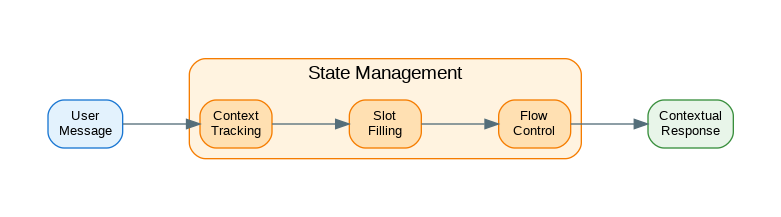
Introduction: Conversational AI applications need to track state across turns—remembering what users said, what information has been collected, and where they are in multi-step workflows. Unlike simple Q&A, task-oriented conversations require slot filling, context tracking, and flow control. This guide covers practical state management patterns: conversation context objects, slot-based information extraction, finite state machines for dialog flow, branching conversations, and persistence strategies that enable conversations to resume across sessions.
Conversation Context
from dataclasses import dataclass, field
from typing import Any, Optional
from datetime import datetime
from enum import Enum

class ConversationPhase(str, Enum):
    GREETING = "greeting"
    INFORMATION_GATHERING = "information_gathering"
    PROCESSING = "processing"
    CONFIRMATION = "confirmation"
    COMPLETION = "completion"

@dataclass
class ConversationContext:
    """Track conversation state and context."""

    session_id: str
    user_id: Optional[str] = None
    phase: ConversationPhase = ConversationPhase.GREETING

    # Collected information
    slots: dict[str, Any] = field(default_factory=dict)

    # Conversation history
    messages: list[dict] = field(default_factory=list)

    # Metadata
    created_at: datetime = field(default_factory=datetime.now)
    updated_at: datetime = field(default_factory=datetime.now)
    turn_count: int = 0

    # Custom data
    metadata: dict = field(default_factory=dict)

    def add_message(self, role: str, content: str):
        """Add message to history."""

        self.messages.append({
            "role": role,
            "content": content,
            "timestamp": datetime.now().isoformat()
        })
        self.turn_count += 1
        self.updated_at = datetime.now()

    def set_slot(self, name: str, value: Any):
        """Set a slot value."""

        self.slots[name] = value
        self.updated_at = datetime.now()

    def get_slot(self, name: str, default: Any = None) -> Any:
        """Get a slot value."""

        return self.slots.get(name, default)

    def has_slot(self, name: str) -> bool:
        """Check if slot is filled."""

        return name in self.slots and self.slots[name] is not None

    def clear_slot(self, name: str):
        """Clear a slot."""

        if name in self.slots:
            del self.slots[name]

    def transition_to(self, phase: ConversationPhase):
        """Transition to new phase."""

        self.phase = phase
        self.updated_at = datetime.now()

    def get_recent_messages(self, count: int = 10) -> list[dict]:
        """Get recent messages for context."""

        return self.messages[-count:]

    def to_dict(self) -> dict:
        """Serialize to dictionary."""

        return {
            "session_id": self.session_id,
            "user_id": self.user_id,
            "phase": self.phase.value,
            "slots": self.slots,
            "messages": self.messages,
            "turn_count": self.turn_count,
            "metadata": self.metadata
        }

    @classmethod
    def from_dict(cls, data: dict) -> "ConversationContext":
        """Deserialize from dictionary."""

        ctx = cls(
            session_id=data["session_id"],
            user_id=data.get("user_id"),
            phase=ConversationPhase(data.get("phase", "greeting")),
            turn_count=data.get("turn_count", 0),
            metadata=data.get("metadata", {})
        )
        ctx.slots = data.get("slots", {})
        ctx.messages = data.get("messages", [])
        return ctx

class ContextManager:
    """Manage conversation contexts."""

    def __init__(self):
        self.contexts: dict[str, ConversationContext] = {}

    def get_or_create(self, session_id: str) -> ConversationContext:
        """Get existing context or create new one."""

        if session_id not in self.contexts:
            self.contexts[session_id] = ConversationContext(
                session_id=session_id
            )

        return self.contexts[session_id]

    def delete(self, session_id: str):
        """Delete a context."""

        if session_id in self.contexts:
            del self.contexts[session_id]
Slot Filling
from dataclasses import dataclass
from typing import Callable, Optional, Any
from enum import Enum

class SlotType(str, Enum):
    STRING = "string"
    INTEGER = "integer"
    FLOAT = "float"
    BOOLEAN = "boolean"
    DATE = "date"
    EMAIL = "email"
    PHONE = "phone"
    CHOICE = "choice"

@dataclass
class SlotDefinition:
    """Definition of a slot to fill."""

    name: str
    slot_type: SlotType
    prompt: str
    required: bool = True
    choices: list[str] = None
    validator: Callable[[Any], bool] = None
    extractor: Callable[[str], Any] = None

class SlotFiller:
    """Extract and validate slot values from user input."""

    def __init__(self, client):
        self.client = client
        self.slots: dict[str, SlotDefinition] = {}

    def register_slot(self, slot: SlotDefinition):
        """Register a slot definition."""

        self.slots[slot.name] = slot

    def extract_slots(
        self,
        user_input: str,
        target_slots: list[str] = None
    ) -> dict[str, Any]:
        """Extract slot values from user input."""

        slots_to_extract = target_slots or list(self.slots.keys())

        # Build extraction prompt
        slot_descriptions = []
        for name in slots_to_extract:
            slot = self.slots.get(name)
            if slot:
                desc = f"- {name} ({slot.slot_type.value}): {slot.prompt}"
                if slot.choices:
                    desc += f" Options: {', '.join(slot.choices)}"
                slot_descriptions.append(desc)

        prompt = f"""Extract the following information from the user's message.
Return JSON with the slot names as keys. Use null for missing values.

Slots to extract:
{chr(10).join(slot_descriptions)}

User message: {user_input}

JSON response:"""

        response = self.client.chat.completions.create(
            model="gpt-4o-mini",
            messages=[{"role": "user", "content": prompt}],
            response_format={"type": "json_object"}
        )

        import json
        extracted = json.loads(response.choices[0].message.content)

        # Validate extracted values
        validated = {}
        for name, value in extracted.items():
            if value is not None and name in self.slots:
                slot = self.slots[name]

                # Type conversion
                value = self._convert_type(value, slot.slot_type)

                # Custom validation
                if slot.validator and not slot.validator(value):
                    continue

                # Choice validation
                if slot.choices and value not in slot.choices:
                    continue

                validated[name] = value

        return validated

    def _convert_type(self, value: Any, slot_type: SlotType) -> Any:
        """Convert value to slot type."""

        try:
            if slot_type == SlotType.INTEGER:
                return int(value)
            elif slot_type == SlotType.FLOAT:
                return float(value)
            elif slot_type == SlotType.BOOLEAN:
                if isinstance(value, bool):
                    return value
                return str(value).lower() in ("true", "yes", "1")
            else:
                return str(value)
        except:
            return value

    def get_missing_slots(
        self,
        context: ConversationContext,
        required_only: bool = True
    ) -> list[SlotDefinition]:
        """Get slots that still need to be filled."""

        missing = []

        for name, slot in self.slots.items():
            if required_only and not slot.required:
                continue

            if not context.has_slot(name):
                missing.append(slot)

        return missing

    def get_next_prompt(
        self,
        context: ConversationContext
    ) -> Optional[str]:
        """Get prompt for next missing slot."""

        missing = self.get_missing_slots(context)

        if missing:
            return missing[0].prompt

        return None

# Form-based slot filling
class FormFiller:
    """Fill a form through conversation."""

    def __init__(self, client, slots: list[SlotDefinition]):
        self.client = client
        self.slot_filler = SlotFiller(client)

        for slot in slots:
            self.slot_filler.register_slot(slot)

        self.slot_order = [s.name for s in slots]

    def process_input(
        self,
        context: ConversationContext,
        user_input: str
    ) -> dict:
        """Process user input and update context."""

        # Extract slots from input
        extracted = self.slot_filler.extract_slots(user_input)

        # Update context
        for name, value in extracted.items():
            context.set_slot(name, value)

        # Check completion
        missing = self.slot_filler.get_missing_slots(context)

        if not missing:
            return {
                "complete": True,
                "slots": context.slots
            }

        # Get next prompt
        next_prompt = missing[0].prompt

        return {
            "complete": False,
            "next_prompt": next_prompt,
            "missing_slots": [s.name for s in missing],
            "filled_slots": list(context.slots.keys())
        }
Dialog Flow Control
from dataclasses import dataclass
from typing import Callable, Optional
from enum import Enum

@dataclass
class DialogState:
    """A state in the dialog flow."""

    name: str
    entry_action: Callable[[ConversationContext], str] = None
    transitions: dict[str, str] = None  # condition -> next_state

class DialogFlow:
    """Finite state machine for dialog control."""

    def __init__(self):
        self.states: dict[str, DialogState] = {}
        self.initial_state: str = None

    def add_state(
        self,
        name: str,
        entry_action: Callable[[ConversationContext], str] = None,
        transitions: dict[str, str] = None,
        is_initial: bool = False
    ):
        """Add a state to the flow."""

        self.states[name] = DialogState(
            name=name,
            entry_action=entry_action,
            transitions=transitions or {}
        )

        if is_initial:
            self.initial_state = name

    def get_current_state(self, context: ConversationContext) -> DialogState:
        """Get current state from context."""

        state_name = context.metadata.get("dialog_state", self.initial_state)
        return self.states.get(state_name)

    def transition(
        self,
        context: ConversationContext,
        condition: str
    ) -> Optional[str]:
        """Transition to next state based on condition."""

        current = self.get_current_state(context)

        if not current:
            return None

        next_state_name = current.transitions.get(condition)

        if next_state_name and next_state_name in self.states:
            context.metadata["dialog_state"] = next_state_name

            next_state = self.states[next_state_name]

            if next_state.entry_action:
                return next_state.entry_action(context)

        return None

    def process(
        self,
        context: ConversationContext,
        user_input: str
    ) -> str:
        """Process user input and return response."""

        current = self.get_current_state(context)

        if not current:
            context.metadata["dialog_state"] = self.initial_state
            current = self.states[self.initial_state]

        # Determine condition from input
        condition = self._classify_input(user_input, current)

        # Try to transition
        response = self.transition(context, condition)

        if response:
            return response

        # Stay in current state
        if current.entry_action:
            return current.entry_action(context)

        return "I'm not sure how to proceed. Can you rephrase?"

    def _classify_input(
        self,
        user_input: str,
        current_state: DialogState
    ) -> str:
        """Classify user input to determine transition."""

        # Simple keyword matching
        input_lower = user_input.lower()

        if any(w in input_lower for w in ["yes", "correct", "right", "confirm"]):
            return "confirm"

        if any(w in input_lower for w in ["no", "wrong", "cancel", "stop"]):
            return "cancel"

        if any(w in input_lower for w in ["help", "what", "how"]):
            return "help"

        return "input"

# Example: Booking flow
def create_booking_flow(client) -> DialogFlow:
    """Create a booking dialog flow."""

    flow = DialogFlow()

    # Greeting state
    flow.add_state(
        name="greeting",
        entry_action=lambda ctx: "Hello! I can help you book an appointment. What service do you need?",
        transitions={
            "input": "collect_service"
        },
        is_initial=True
    )

    # Collect service
    flow.add_state(
        name="collect_service",
        entry_action=lambda ctx: "What date works best for you?",
        transitions={
            "input": "collect_date"
        }
    )

    # Collect date
    flow.add_state(
        name="collect_date",
        entry_action=lambda ctx: "What time would you prefer?",
        transitions={
            "input": "collect_time"
        }
    )

    # Collect time
    flow.add_state(
        name="collect_time",
        entry_action=lambda ctx: f"Great! Let me confirm: {ctx.slots}. Is this correct?",
        transitions={
            "confirm": "confirmed",
            "cancel": "greeting"
        }
    )

    # Confirmed
    flow.add_state(
        name="confirmed",
        entry_action=lambda ctx: "Your appointment is booked! Is there anything else?",
        transitions={
            "input": "greeting",
            "cancel": "goodbye"
        }
    )

    # Goodbye
    flow.add_state(
        name="goodbye",
        entry_action=lambda ctx: "Thank you! Have a great day!",
        transitions={}
    )

    return flow
Branching Conversations
from dataclasses import dataclass
from typing import Callable, Optional

@dataclass
class ConversationBranch:
    """A branch in the conversation tree."""

    name: str
    condition: Callable[[ConversationContext, str], bool]
    handler: Callable[[ConversationContext, str], str]
    priority: int = 0

class BranchingConversation:
    """Handle branching conversation flows."""

    def __init__(self, client):
        self.client = client
        self.branches: list[ConversationBranch] = []
        self.default_handler: Callable = None

    def add_branch(
        self,
        name: str,
        condition: Callable[[ConversationContext, str], bool],
        handler: Callable[[ConversationContext, str], str],
        priority: int = 0
    ):
        """Add a conversation branch."""

        self.branches.append(ConversationBranch(
            name=name,
            condition=condition,
            handler=handler,
            priority=priority
        ))

        # Sort by priority
        self.branches.sort(key=lambda b: b.priority, reverse=True)

    def set_default(self, handler: Callable[[ConversationContext, str], str]):
        """Set default handler."""

        self.default_handler = handler

    def process(
        self,
        context: ConversationContext,
        user_input: str
    ) -> str:
        """Process input through branches."""

        for branch in self.branches:
            if branch.condition(context, user_input):
                context.metadata["current_branch"] = branch.name
                return branch.handler(context, user_input)

        if self.default_handler:
            return self.default_handler(context, user_input)

        return "I'm not sure how to help with that."

# Intent-based branching
class IntentRouter:
    """Route conversations based on intent."""

    def __init__(self, client):
        self.client = client
        self.intent_handlers: dict[str, Callable] = {}

    def register_intent(
        self,
        intent: str,
        handler: Callable[[ConversationContext, str], str]
    ):
        """Register handler for intent."""

        self.intent_handlers[intent] = handler

    def classify_intent(self, user_input: str) -> str:
        """Classify user intent using LLM."""

        intents = list(self.intent_handlers.keys())

        prompt = f"""Classify the user's intent into one of these categories:
{', '.join(intents)}

User message: {user_input}

Intent (just the category name):"""

        response = self.client.chat.completions.create(
            model="gpt-4o-mini",
            messages=[{"role": "user", "content": prompt}],
            max_tokens=20
        )

        intent = response.choices[0].message.content.strip().lower()

        # Find matching intent
        for registered in intents:
            if registered.lower() in intent:
                return registered

        return "unknown"

    def process(
        self,
        context: ConversationContext,
        user_input: str
    ) -> str:
        """Process input based on intent."""

        intent = self.classify_intent(user_input)
        context.metadata["last_intent"] = intent

        handler = self.intent_handlers.get(intent)

        if handler:
            return handler(context, user_input)

        return "I'm not sure how to help with that. Can you rephrase?"

# Sub-conversation handling
class SubConversation:
    """Handle nested sub-conversations."""

    def __init__(self, name: str, handler: Callable):
        self.name = name
        self.handler = handler
        self.is_active = False

    def start(self, context: ConversationContext) -> str:
        """Start sub-conversation."""

        self.is_active = True
        context.metadata["sub_conversation"] = self.name
        return self.handler(context, "__start__")

    def process(self, context: ConversationContext, user_input: str) -> str:
        """Process input in sub-conversation."""

        result = self.handler(context, user_input)

        if result == "__end__":
            self.end(context)
            return None

        return result

    def end(self, context: ConversationContext):
        """End sub-conversation."""

        self.is_active = False
        context.metadata.pop("sub_conversation", None)
State Persistence
from abc import ABC, abstractmethod
from typing import Optional
import json

class StateStore(ABC):
    """Abstract state storage."""

    @abstractmethod
    def save(self, session_id: str, context: ConversationContext):
        pass

    @abstractmethod
    def load(self, session_id: str) -> Optional[ConversationContext]:
        pass

    @abstractmethod
    def delete(self, session_id: str):
        pass

class InMemoryStore(StateStore):
    """In-memory state storage."""

    def __init__(self):
        self.store: dict[str, dict] = {}

    def save(self, session_id: str, context: ConversationContext):
        self.store[session_id] = context.to_dict()

    def load(self, session_id: str) -> Optional[ConversationContext]:
        data = self.store.get(session_id)
        if data:
            return ConversationContext.from_dict(data)
        return None

    def delete(self, session_id: str):
        self.store.pop(session_id, None)

class RedisStore(StateStore):
    """Redis-based state storage."""

    def __init__(self, redis_url: str, ttl: int = 3600):
        import redis
        self.client = redis.from_url(redis_url)
        self.ttl = ttl

    def save(self, session_id: str, context: ConversationContext):
        key = f"conversation:{session_id}"
        data = json.dumps(context.to_dict())
        self.client.setex(key, self.ttl, data)

    def load(self, session_id: str) -> Optional[ConversationContext]:
        key = f"conversation:{session_id}"
        data = self.client.get(key)

        if data:
            return ConversationContext.from_dict(json.loads(data))
        return None

    def delete(self, session_id: str):
        key = f"conversation:{session_id}"
        self.client.delete(key)

class FileStore(StateStore):
    """File-based state storage."""

    def __init__(self, directory: str):
        import os
        self.directory = directory
        os.makedirs(directory, exist_ok=True)

    def _get_path(self, session_id: str) -> str:
        return f"{self.directory}/{session_id}.json"

    def save(self, session_id: str, context: ConversationContext):
        path = self._get_path(session_id)
        with open(path, 'w') as f:
            json.dump(context.to_dict(), f)

    def load(self, session_id: str) -> Optional[ConversationContext]:
        import os
        path = self._get_path(session_id)

        if os.path.exists(path):
            with open(path, 'r') as f:
                return ConversationContext.from_dict(json.load(f))
        return None

    def delete(self, session_id: str):
        import os
        path = self._get_path(session_id)
        if os.path.exists(path):
            os.remove(path)

# Conversation manager with persistence
class PersistentConversationManager:
    """Manage conversations with persistence."""

    def __init__(self, store: StateStore):
        self.store = store

    def get_context(self, session_id: str) -> ConversationContext:
        """Get or create conversation context."""

        context = self.store.load(session_id)

        if not context:
            context = ConversationContext(session_id=session_id)

        return context

    def save_context(self, context: ConversationContext):
        """Save conversation context."""

        self.store.save(context.session_id, context)

    def end_conversation(self, session_id: str):
        """End and delete conversation."""

        self.store.delete(session_id)
Production Conversation Service
from fastapi import FastAPI, HTTPException
from pydantic import BaseModel
from typing import Optional
import uuid

app = FastAPI()

# Initialize components
from openai import OpenAI
client = OpenAI()

store = InMemoryStore()
manager = PersistentConversationManager(store)

# Setup slot filler
slot_filler = SlotFiller(client)
slot_filler.register_slot(SlotDefinition(
    name="name",
    slot_type=SlotType.STRING,
    prompt="What's your name?"
))
slot_filler.register_slot(SlotDefinition(
    name="email",
    slot_type=SlotType.EMAIL,
    prompt="What's your email address?"
))
slot_filler.register_slot(SlotDefinition(
    name="service",
    slot_type=SlotType.CHOICE,
    prompt="What service do you need?",
    choices=["consultation", "support", "sales"]
))

class ChatRequest(BaseModel):
    session_id: Optional[str] = None
    message: str

@app.post("/v1/chat")
async def chat(request: ChatRequest):
    """Process chat message with state management."""

    # Get or create session
    session_id = request.session_id or str(uuid.uuid4())
    context = manager.get_context(session_id)

    # Add user message
    context.add_message("user", request.message)

    # Extract slots
    extracted = slot_filler.extract_slots(request.message)
    for name, value in extracted.items():
        context.set_slot(name, value)

    # Check for missing slots
    missing = slot_filler.get_missing_slots(context)

    if missing:
        response = missing[0].prompt
    else:
        # All slots filled - generate response
        response = await generate_response(context, request.message)

    # Add assistant message
    context.add_message("assistant", response)

    # Save context
    manager.save_context(context)

    return {
        "session_id": session_id,
        "response": response,
        "slots": context.slots,
        "phase": context.phase.value
    }

async def generate_response(context: ConversationContext, user_input: str) -> str:
    """Generate contextual response."""

    # Build context for LLM
    system_prompt = f"""You are a helpful assistant.
User information: {context.slots}
Conversation phase: {context.phase.value}"""

    messages = [{"role": "system", "content": system_prompt}]
    messages.extend(context.get_recent_messages(10))

    response = client.chat.completions.create(
        model="gpt-4o-mini",
        messages=messages
    )

    return response.choices[0].message.content

@app.get("/v1/session/{session_id}")
async def get_session(session_id: str):
    """Get session state."""

    context = manager.get_context(session_id)

    return {
        "session_id": session_id,
        "slots": context.slots,
        "phase": context.phase.value,
        "turn_count": context.turn_count
    }

@app.delete("/v1/session/{session_id}")
async def end_session(session_id: str):
    """End session."""

    manager.end_conversation(session_id)
    return {"deleted": True}

@app.get("/health")
async def health():
    return {"status": "healthy"}
References
- Rasa Dialog Management: https://rasa.com/docs/rasa/dialogue-policies
- Dialogflow CX: https://cloud.google.com/dialogflow/cx/docs
- LangChain Conversation: https://python.langchain.com/docs/modules/memory/
- Finite State Machines: https://en.wikipedia.org/wiki/Finite-state_machine
Conclusion
Effective conversation state management transforms chatbots from simple Q&A systems into capable task-oriented assistants. Use conversation context objects to track all relevant information across turns. Implement slot filling for structured information gathering—define slots with types, validators, and prompts. Use dialog flows (finite state machines) for predictable multi-step processes. Add branching logic for handling different user intents and conversation paths. Persist state to enable conversations that resume across sessions. The key is balancing structure with flexibility—enough state tracking to maintain context, but enough LLM involvement to handle unexpected inputs gracefully.
Discover more from C4: Container, Code, Cloud & Context
Subscribe to get the latest posts sent to your email.