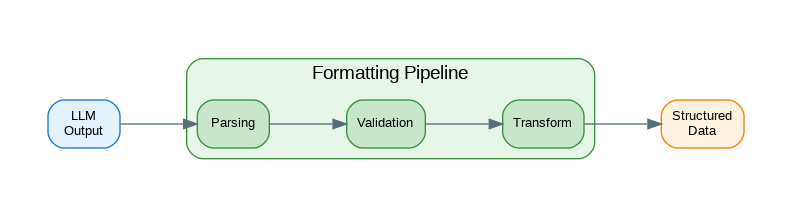
Introduction: LLM outputs are inherently unstructured text, but applications need structured data—JSON objects, typed responses, specific formats. Getting reliable structured output requires careful prompt engineering, output parsing, validation, and error recovery. This guide covers practical output formatting techniques: JSON mode and structured outputs, Pydantic-based parsing, format enforcement with retries, template-based formatting, and strategies for handling malformed outputs gracefully.
JSON Mode and Structured Outputs
from openai import OpenAI
from pydantic import BaseModel, Field
from typing import Optional
import json

client = OpenAI()

# Basic JSON mode
def get_json_response(prompt: str) -> dict:
    """Get JSON response using JSON mode."""

    response = client.chat.completions.create(
        model="gpt-4o-mini",
        messages=[
            {
                "role": "system",
                "content": "You are a helpful assistant that responds in JSON format."
            },
            {"role": "user", "content": prompt}
        ],
        response_format={"type": "json_object"}
    )

    return json.loads(response.choices[0].message.content)

# Structured outputs with schema
class ProductReview(BaseModel):
    """Schema for product review analysis."""

    sentiment: str = Field(description="positive, negative, or neutral")
    score: float = Field(description="Sentiment score from 0 to 1")
    key_points: list[str] = Field(description="Main points from the review")
    recommendation: bool = Field(description="Whether reviewer recommends product")

def analyze_review_structured(review_text: str) -> ProductReview:
    """Analyze review using structured outputs."""

    response = client.beta.chat.completions.parse(
        model="gpt-4o-mini",
        messages=[
            {
                "role": "system",
                "content": "Analyze the product review and extract structured information."
            },
            {"role": "user", "content": review_text}
        ],
        response_format=ProductReview
    )

    return response.choices[0].message.parsed

# Complex nested schema
class Address(BaseModel):
    street: str
    city: str
    state: str
    zip_code: str
    country: str = "USA"

class Person(BaseModel):
    name: str
    email: Optional[str] = None
    phone: Optional[str] = None
    address: Optional[Address] = None

class ExtractedEntities(BaseModel):
    """Extracted entities from text."""

    people: list[Person] = Field(default_factory=list)
    organizations: list[str] = Field(default_factory=list)
    dates: list[str] = Field(default_factory=list)
    locations: list[str] = Field(default_factory=list)

def extract_entities(text: str) -> ExtractedEntities:
    """Extract entities using structured output."""

    response = client.beta.chat.completions.parse(
        model="gpt-4o-mini",
        messages=[
            {
                "role": "system",
                "content": "Extract all entities from the text."
            },
            {"role": "user", "content": text}
        ],
        response_format=ExtractedEntities
    )

    return response.choices[0].message.parsed

# Enum constraints
from enum import Enum

class Priority(str, Enum):
    LOW = "low"
    MEDIUM = "medium"
    HIGH = "high"
    CRITICAL = "critical"

class TaskClassification(BaseModel):
    """Task classification result."""

    category: str
    priority: Priority
    estimated_hours: float
    requires_approval: bool
    tags: list[str]

def classify_task(task_description: str) -> TaskClassification:
    """Classify task with enum constraints."""

    response = client.beta.chat.completions.parse(
        model="gpt-4o-mini",
        messages=[
            {
                "role": "system",
                "content": "Classify the task and estimate effort."
            },
            {"role": "user", "content": task_description}
        ],
        response_format=TaskClassification
    )

    return response.choices[0].message.parsed
Pydantic-Based Parsing
from pydantic import BaseModel, Field, validator, field_validator
from typing import Any, Optional
import json
import re

class OutputParser:
    """Parse LLM outputs into Pydantic models."""

    def __init__(self, model: type[BaseModel]):
        self.model = model

    def parse(self, text: str) -> BaseModel:
        """Parse text into model."""

        # Try to extract JSON from text
        json_str = self._extract_json(text)

        if json_str:
            data = json.loads(json_str)
            return self.model.model_validate(data)

        raise ValueError(f"Could not parse output: {text[:100]}")

    def _extract_json(self, text: str) -> Optional[str]:
        """Extract JSON from text that may contain other content."""

        # Try direct parse first
        try:
            json.loads(text)
            return text
        except:
            pass

        # Look for JSON in code blocks
        code_block_pattern = r"```(?:json)?\s*([\s\S]*?)```"
        matches = re.findall(code_block_pattern, text)

        for match in matches:
            try:
                json.loads(match.strip())
                return match.strip()
            except:
                continue

        # Look for JSON objects
        brace_pattern = r"\{[\s\S]*\}"
        matches = re.findall(brace_pattern, text)

        for match in matches:
            try:
                json.loads(match)
                return match
            except:
                continue

        return None

    def get_format_instructions(self) -> str:
        """Get format instructions for the model."""

        schema = self.model.model_json_schema()

        return f"""Respond with a JSON object matching this schema:
{json.dumps(schema, indent=2)}

Important: Return ONLY the JSON object, no additional text."""

# Validated models
class ValidatedResponse(BaseModel):
    """Response with custom validation."""

    answer: str = Field(min_length=10)
    confidence: float = Field(ge=0.0, le=1.0)
    sources: list[str] = Field(min_length=1)

    @field_validator('sources')
    @classmethod
    def validate_sources(cls, v):
        """Ensure sources are URLs or valid references."""

        for source in v:
            if not (source.startswith('http') or len(source) > 5):
                raise ValueError(f"Invalid source: {source}")
        return v

class DateRange(BaseModel):
    """Date range with validation."""

    start_date: str
    end_date: str

    @field_validator('start_date', 'end_date')
    @classmethod
    def validate_date_format(cls, v):
        """Validate date format."""

        from datetime import datetime
        try:
            datetime.strptime(v, "%Y-%m-%d")
        except ValueError:
            raise ValueError(f"Date must be YYYY-MM-DD format: {v}")
        return v

# Flexible parsing with defaults
class FlexibleParser:
    """Parser that handles partial/malformed outputs."""

    def __init__(self, model: type[BaseModel]):
        self.model = model

    def parse_with_defaults(
        self,
        text: str,
        defaults: dict = None
    ) -> BaseModel:
        """Parse with fallback to defaults."""

        defaults = defaults or {}

        try:
            # Try normal parsing
            json_str = self._extract_json(text)
            if json_str:
                data = json.loads(json_str)
                # Merge with defaults
                merged = {**defaults, **data}
                return self.model.model_validate(merged)
        except Exception as e:
            pass

        # Return model with defaults
        return self.model.model_validate(defaults)

    def _extract_json(self, text: str) -> Optional[str]:
        """Extract JSON from text."""

        # Same as OutputParser._extract_json
        try:
            json.loads(text)
            return text
        except:
            pass

        brace_pattern = r"\{[\s\S]*\}"
        matches = re.findall(brace_pattern, text)

        for match in matches:
            try:
                json.loads(match)
                return match
            except:
                continue

        return None
Format Enforcement with Retries
from dataclasses import dataclass
from typing import TypeVar, Generic

T = TypeVar('T', bound=BaseModel)

@dataclass
class ParseResult(Generic[T]):
    """Result of parsing attempt."""

    success: bool
    result: Optional[T] = None
    error: Optional[str] = None
    attempts: int = 0

class RetryingParser(Generic[T]):
    """Parser with automatic retry on failure."""

    def __init__(
        self,
        client,
        model_class: type[T],
        max_retries: int = 3
    ):
        self.client = client
        self.model_class = model_class
        self.max_retries = max_retries
        self.parser = OutputParser(model_class)

    def parse_with_retry(
        self,
        prompt: str,
        system_prompt: str = None
    ) -> ParseResult[T]:
        """Parse with automatic retry on failure."""

        messages = []

        if system_prompt:
            messages.append({"role": "system", "content": system_prompt})

        # Add format instructions
        format_instructions = self.parser.get_format_instructions()
        full_prompt = f"{prompt}\n\n{format_instructions}"
        messages.append({"role": "user", "content": full_prompt})

        last_error = None

        for attempt in range(self.max_retries):
            try:
                response = self.client.chat.completions.create(
                    model="gpt-4o-mini",
                    messages=messages,
                    response_format={"type": "json_object"}
                )

                content = response.choices[0].message.content
                result = self.parser.parse(content)

                return ParseResult(
                    success=True,
                    result=result,
                    attempts=attempt + 1
                )

            except Exception as e:
                last_error = str(e)

                # Add error feedback for retry
                messages.append({
                    "role": "assistant",
                    "content": content if 'content' in dir() else ""
                })
                messages.append({
                    "role": "user",
                    "content": f"That response had an error: {last_error}. Please try again with valid JSON matching the schema."
                })

        return ParseResult(
            success=False,
            error=last_error,
            attempts=self.max_retries
        )

# Self-correcting parser
class SelfCorrectingParser(Generic[T]):
    """Parser that uses LLM to fix malformed outputs."""

    def __init__(self, client, model_class: type[T]):
        self.client = client
        self.model_class = model_class

    def parse_and_correct(self, text: str) -> T:
        """Parse with LLM-assisted correction."""

        # Try direct parsing first
        try:
            data = json.loads(text)
            return self.model_class.model_validate(data)
        except Exception as initial_error:
            pass

        # Ask LLM to fix the output
        schema = self.model_class.model_json_schema()

        correction_prompt = f"""The following text should be valid JSON matching this schema:
{json.dumps(schema, indent=2)}

Text to fix:
{text}

Return ONLY the corrected JSON, no explanation."""

        response = self.client.chat.completions.create(
            model="gpt-4o-mini",
            messages=[{"role": "user", "content": correction_prompt}],
            response_format={"type": "json_object"}
        )

        corrected = response.choices[0].message.content
        data = json.loads(corrected)
        return self.model_class.model_validate(data)

# Streaming parser
class StreamingParser:
    """Parse structured output from streaming response."""

    def __init__(self, model_class: type[BaseModel]):
        self.model_class = model_class
        self.buffer = ""

    def feed(self, chunk: str) -> Optional[BaseModel]:
        """Feed chunk and try to parse."""

        self.buffer += chunk

        # Try to parse complete JSON
        try:
            # Look for complete JSON object
            if self.buffer.count('{') == self.buffer.count('}'):
                data = json.loads(self.buffer)
                return self.model_class.model_validate(data)
        except:
            pass

        return None

    def reset(self):
        """Reset buffer."""
        self.buffer = ""
Template-Based Formatting
from dataclasses import dataclass
from typing import Callable
import re

@dataclass
class OutputTemplate:
    """Template for structured output."""

    name: str
    template: str
    parser: Callable[[str], dict]

class TemplateFormatter:
    """Format outputs using templates."""

    def __init__(self):
        self.templates: dict[str, OutputTemplate] = {}

    def register_template(
        self,
        name: str,
        template: str,
        parser: Callable[[str], dict] = None
    ):
        """Register an output template."""

        self.templates[name] = OutputTemplate(
            name=name,
            template=template,
            parser=parser or self._default_parser
        )

    def get_format_prompt(self, template_name: str) -> str:
        """Get format instructions for template."""

        template = self.templates.get(template_name)
        if not template:
            raise ValueError(f"Unknown template: {template_name}")

        return f"""Format your response exactly like this template:

{template.template}

Fill in the bracketed sections with appropriate content."""

    def parse_output(self, template_name: str, output: str) -> dict:
        """Parse output using template."""

        template = self.templates.get(template_name)
        if not template:
            raise ValueError(f"Unknown template: {template_name}")

        return template.parser(output)

    def _default_parser(self, output: str) -> dict:
        """Default parser extracts key-value pairs."""

        result = {}

        # Look for "Key: Value" patterns
        pattern = r"^([A-Za-z_]+):\s*(.+)$"

        for line in output.split('\n'):
            match = re.match(pattern, line.strip())
            if match:
                key = match.group(1).lower()
                value = match.group(2).strip()
                result[key] = value

        return result

# Common templates
def setup_common_templates(formatter: TemplateFormatter):
    """Setup common output templates."""

    # Summary template
    formatter.register_template(
        name="summary",
        template="""Summary: [Brief summary in 2-3 sentences]

Key Points:
- [Point 1]
- [Point 2]
- [Point 3]

Conclusion: [Final takeaway]""",
        parser=lambda x: parse_summary(x)
    )

    # Analysis template
    formatter.register_template(
        name="analysis",
        template="""Topic: [Main topic]

Analysis:
[Detailed analysis paragraph]

Pros:
- [Pro 1]
- [Pro 2]

Cons:
- [Con 1]
- [Con 2]

Recommendation: [Your recommendation]""",
        parser=lambda x: parse_analysis(x)
    )

    # Code review template
    formatter.register_template(
        name="code_review",
        template="""Overall Assessment: [Good/Needs Work/Poor]

Issues Found:
1. [Issue description] - Severity: [High/Medium/Low]
2. [Issue description] - Severity: [High/Medium/Low]

Suggestions:
- [Suggestion 1]
- [Suggestion 2]

Code Quality Score: [1-10]""",
        parser=lambda x: parse_code_review(x)
    )

def parse_summary(output: str) -> dict:
    """Parse summary template output."""

    result = {"key_points": []}

    lines = output.split('\n')
    current_section = None

    for line in lines:
        line = line.strip()

        if line.startswith("Summary:"):
            result["summary"] = line.replace("Summary:", "").strip()
        elif line.startswith("Conclusion:"):
            result["conclusion"] = line.replace("Conclusion:", "").strip()
        elif line.startswith("Key Points:"):
            current_section = "key_points"
        elif line.startswith("- ") and current_section == "key_points":
            result["key_points"].append(line[2:])

    return result

def parse_analysis(output: str) -> dict:
    """Parse analysis template output."""

    result = {"pros": [], "cons": []}

    lines = output.split('\n')
    current_section = None

    for line in lines:
        line = line.strip()

        if line.startswith("Topic:"):
            result["topic"] = line.replace("Topic:", "").strip()
        elif line.startswith("Recommendation:"):
            result["recommendation"] = line.replace("Recommendation:", "").strip()
        elif line == "Pros:":
            current_section = "pros"
        elif line == "Cons:":
            current_section = "cons"
        elif line.startswith("- "):
            if current_section in result:
                result[current_section].append(line[2:])

    return result

def parse_code_review(output: str) -> dict:
    """Parse code review template output."""

    result = {"issues": [], "suggestions": []}

    lines = output.split('\n')
    current_section = None

    for line in lines:
        line = line.strip()

        if line.startswith("Overall Assessment:"):
            result["assessment"] = line.replace("Overall Assessment:", "").strip()
        elif line.startswith("Code Quality Score:"):
            score_str = line.replace("Code Quality Score:", "").strip()
            try:
                result["score"] = int(score_str.split('/')[0])
            except:
                result["score"] = None
        elif "Issues Found:" in line:
            current_section = "issues"
        elif "Suggestions:" in line:
            current_section = "suggestions"
        elif line.startswith("- ") and current_section == "suggestions":
            result["suggestions"].append(line[2:])
        elif re.match(r"^\d+\.", line) and current_section == "issues":
            result["issues"].append(line)
Production Output Service
from fastapi import FastAPI, HTTPException
from pydantic import BaseModel
from typing import Any, Optional

app = FastAPI()

# Initialize components
from openai import OpenAI
client = OpenAI()

# Define output schemas
class SentimentResult(BaseModel):
    sentiment: str
    confidence: float
    explanation: str

class SummaryResult(BaseModel):
    summary: str
    key_points: list[str]
    word_count: int

class ExtractionResult(BaseModel):
    entities: list[dict]
    relationships: list[dict]

# Initialize parsers
sentiment_parser = RetryingParser(client, SentimentResult)
summary_parser = RetryingParser(client, SummaryResult)

class AnalyzeRequest(BaseModel):
    text: str
    output_type: str  # sentiment, summary, extraction
    schema: Optional[dict] = None

@app.post("/v1/analyze")
async def analyze_text(request: AnalyzeRequest):
    """Analyze text with structured output."""

    if request.output_type == "sentiment":
        result = sentiment_parser.parse_with_retry(
            f"Analyze the sentiment of this text:\n\n{request.text}",
            system_prompt="You are a sentiment analysis expert."
        )

        if result.success:
            return {
                "type": "sentiment",
                "result": result.result.model_dump(),
                "attempts": result.attempts
            }
        else:
            raise HTTPException(500, f"Parsing failed: {result.error}")

    elif request.output_type == "summary":
        result = summary_parser.parse_with_retry(
            f"Summarize this text:\n\n{request.text}",
            system_prompt="You are a summarization expert."
        )

        if result.success:
            return {
                "type": "summary",
                "result": result.result.model_dump(),
                "attempts": result.attempts
            }
        else:
            raise HTTPException(500, f"Parsing failed: {result.error}")

    elif request.output_type == "extraction":
        # Use structured outputs for custom schema
        response = client.beta.chat.completions.parse(
            model="gpt-4o-mini",
            messages=[
                {
                    "role": "system",
                    "content": "Extract entities and relationships from text."
                },
                {"role": "user", "content": request.text}
            ],
            response_format=ExtractionResult
        )

        return {
            "type": "extraction",
            "result": response.choices[0].message.parsed.model_dump()
        }

    else:
        raise HTTPException(400, f"Unknown output type: {request.output_type}")

class FormatRequest(BaseModel):
    text: str
    template: str

# Template formatter
formatter = TemplateFormatter()
setup_common_templates(formatter)

@app.post("/v1/format")
async def format_output(request: FormatRequest):
    """Format text using template."""

    try:
        format_prompt = formatter.get_format_prompt(request.template)

        response = client.chat.completions.create(
            model="gpt-4o-mini",
            messages=[
                {"role": "system", "content": format_prompt},
                {"role": "user", "content": request.text}
            ]
        )

        output = response.choices[0].message.content
        parsed = formatter.parse_output(request.template, output)

        return {
            "template": request.template,
            "raw_output": output,
            "parsed": parsed
        }

    except ValueError as e:
        raise HTTPException(400, str(e))

@app.get("/v1/templates")
async def list_templates():
    """List available templates."""

    return {
        "templates": list(formatter.templates.keys())
    }

@app.get("/health")
async def health():
    return {"status": "healthy"}
References
- OpenAI Structured Outputs: https://platform.openai.com/docs/guides/structured-outputs
- Pydantic: https://docs.pydantic.dev/
- LangChain Output Parsers: https://python.langchain.com/docs/modules/model_io/output_parsers/
- Instructor Library: https://python.useinstructor.com/
Conclusion
Reliable structured output is essential for production LLM applications. Use JSON mode or structured outputs when available—they significantly reduce parsing failures. Define Pydantic models with validation rules to catch malformed data early. Implement retry logic with error feedback to handle occasional failures gracefully. Use template-based formatting for consistent output structure when JSON isn’t appropriate. For streaming applications, build incremental parsers that can handle partial outputs. The key is defense in depth: clear format instructions, native JSON mode, robust parsing, validation, and graceful error handling. Well-structured outputs make LLM responses predictable and integrable with downstream systems.
Discover more from C4: Container, Code, Cloud & Context
Subscribe to get the latest posts sent to your email.