Introduction: LLM APIs have strict rate limits—requests per minute, tokens per minute, and concurrent request limits. Exceeding these limits results in 429 errors that can cascade through your application. Effective rate limiting on your side prevents hitting API limits, provides fair access across users, and enables graceful degradation under load. This guide covers practical rate limiting patterns: token bucket algorithms, sliding window counters, request queuing, and adaptive throttling that responds to API feedback.
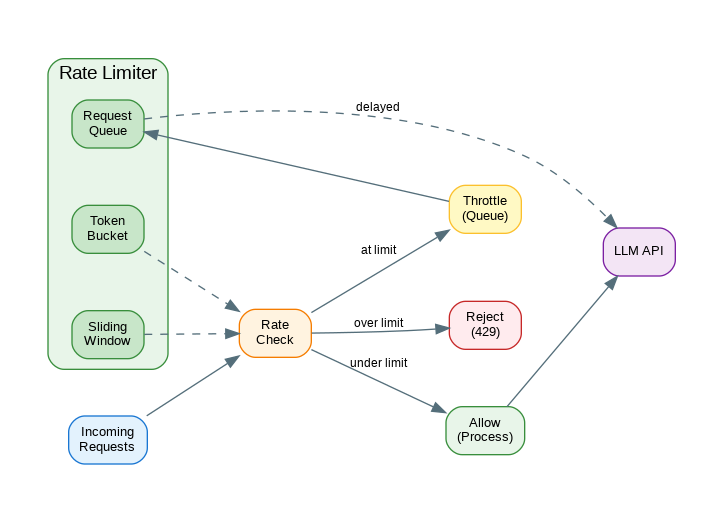
Token Bucket Algorithm
import time
import asyncio
from threading import Lock
from dataclasses import dataclass

@dataclass
class TokenBucketConfig:
    """Configuration for token bucket."""

    capacity: int  # Maximum tokens
    refill_rate: float  # Tokens per second
    initial_tokens: int = None  # Starting tokens (defaults to capacity)

class TokenBucket:
    """Token bucket rate limiter."""

    def __init__(self, config: TokenBucketConfig):
        self.capacity = config.capacity
        self.refill_rate = config.refill_rate
        self.tokens = config.initial_tokens or config.capacity
        self.last_refill = time.time()
        self.lock = Lock()

    def _refill(self):
        """Refill tokens based on elapsed time."""

        now = time.time()
        elapsed = now - self.last_refill

        new_tokens = elapsed * self.refill_rate
        self.tokens = min(self.capacity, self.tokens + new_tokens)
        self.last_refill = now

    def acquire(self, tokens: int = 1) -> bool:
        """Try to acquire tokens. Returns True if successful."""

        with self.lock:
            self._refill()

            if self.tokens >= tokens:
                self.tokens -= tokens
                return True

            return False

    def wait_for_tokens(self, tokens: int = 1) -> float:
        """Calculate wait time for tokens to become available."""

        with self.lock:
            self._refill()

            if self.tokens >= tokens:
                return 0

            needed = tokens - self.tokens
            return needed / self.refill_rate

    async def acquire_async(self, tokens: int = 1) -> bool:
        """Async acquire with waiting."""

        wait_time = self.wait_for_tokens(tokens)

        if wait_time > 0:
            await asyncio.sleep(wait_time)

        return self.acquire(tokens)

# LLM-specific rate limiter
class LLMRateLimiter:
    """Rate limiter for LLM APIs with RPM and TPM limits."""

    def __init__(
        self,
        requests_per_minute: int = 60,
        tokens_per_minute: int = 100000
    ):
        # Request rate limiter
        self.request_bucket = TokenBucket(TokenBucketConfig(
            capacity=requests_per_minute,
            refill_rate=requests_per_minute / 60
        ))

        # Token rate limiter
        self.token_bucket = TokenBucket(TokenBucketConfig(
            capacity=tokens_per_minute,
            refill_rate=tokens_per_minute / 60
        ))

    def can_make_request(self, estimated_tokens: int = 1000) -> bool:
        """Check if request can be made."""

        return (
            self.request_bucket.acquire(1) and
            self.token_bucket.acquire(estimated_tokens)
        )

    async def wait_for_capacity(self, estimated_tokens: int = 1000):
        """Wait until capacity is available."""

        request_wait = self.request_bucket.wait_for_tokens(1)
        token_wait = self.token_bucket.wait_for_tokens(estimated_tokens)

        wait_time = max(request_wait, token_wait)

        if wait_time > 0:
            await asyncio.sleep(wait_time)

        self.request_bucket.acquire(1)
        self.token_bucket.acquire(estimated_tokens)

    def record_actual_tokens(self, actual_tokens: int, estimated_tokens: int):
        """Adjust for actual token usage."""

        diff = actual_tokens - estimated_tokens

        if diff > 0:
            # Used more than estimated, deduct extra
            self.token_bucket.acquire(diff)
        elif diff < 0:
            # Used less, return tokens (up to capacity)
            with self.token_bucket.lock:
                self.token_bucket.tokens = min(
                    self.token_bucket.capacity,
                    self.token_bucket.tokens - diff
                )

# Usage
limiter = LLMRateLimiter(
    requests_per_minute=60,
    tokens_per_minute=100000
)

async def rate_limited_completion(prompt: str) -> str:
    """Make rate-limited LLM call."""

    estimated_tokens = len(prompt.split()) * 2  # Rough estimate

    await limiter.wait_for_capacity(estimated_tokens)

    from openai import OpenAI
    client = OpenAI()

    response = client.chat.completions.create(
        model="gpt-4o-mini",
        messages=[{"role": "user", "content": prompt}]
    )

    actual_tokens = response.usage.total_tokens
    limiter.record_actual_tokens(actual_tokens, estimated_tokens)

    return response.choices[0].message.content
Sliding Window Rate Limiter
from collections import deque
from dataclasses import dataclass
import time

@dataclass
class SlidingWindowConfig:
    """Configuration for sliding window."""

    window_size: float  # Window size in seconds
    max_requests: int  # Maximum requests in window

class SlidingWindowLimiter:
    """Sliding window rate limiter."""

    def __init__(self, config: SlidingWindowConfig):
        self.window_size = config.window_size
        self.max_requests = config.max_requests
        self.requests: deque = deque()
        self.lock = Lock()

    def _cleanup(self):
        """Remove expired requests from window."""

        cutoff = time.time() - self.window_size

        while self.requests and self.requests[0] < cutoff:
            self.requests.popleft()

    def acquire(self) -> bool:
        """Try to acquire a slot in the window."""

        with self.lock:
            self._cleanup()

            if len(self.requests) < self.max_requests:
                self.requests.append(time.time())
                return True

            return False

    def wait_time(self) -> float:
        """Calculate time until a slot is available."""

        with self.lock:
            self._cleanup()

            if len(self.requests) < self.max_requests:
                return 0

            # Wait until oldest request expires
            oldest = self.requests[0]
            return (oldest + self.window_size) - time.time()

    def get_remaining(self) -> int:
        """Get remaining requests in current window."""

        with self.lock:
            self._cleanup()
            return self.max_requests - len(self.requests)

class SlidingWindowCounter:
    """Sliding window counter with sub-window precision."""

    def __init__(
        self,
        window_size: float,
        max_count: int,
        precision: int = 10
    ):
        self.window_size = window_size
        self.max_count = max_count
        self.precision = precision
        self.sub_window = window_size / precision

        self.counts: dict[int, int] = {}
        self.lock = Lock()

    def _get_window_key(self, timestamp: float) -> int:
        """Get sub-window key for timestamp."""
        return int(timestamp / self.sub_window)

    def _cleanup(self, current_key: int):
        """Remove old sub-windows."""

        cutoff = current_key - self.precision

        keys_to_remove = [k for k in self.counts if k < cutoff]
        for k in keys_to_remove:
            del self.counts[k]

    def _get_count(self, current_key: int) -> float:
        """Get weighted count across window."""

        total = 0
        current_time = time.time()
        window_start = current_time - self.window_size

        for key, count in self.counts.items():
            sub_window_start = key * self.sub_window
            sub_window_end = sub_window_start + self.sub_window

            if sub_window_end <= window_start:
                continue

            if sub_window_start >= current_time:
                continue

            # Calculate overlap weight
            overlap_start = max(sub_window_start, window_start)
            overlap_end = min(sub_window_end, current_time)
            weight = (overlap_end - overlap_start) / self.sub_window

            total += count * weight

        return total

    def acquire(self, count: int = 1) -> bool:
        """Try to acquire count."""

        with self.lock:
            current_key = self._get_window_key(time.time())
            self._cleanup(current_key)

            current_count = self._get_count(current_key)

            if current_count + count <= self.max_count:
                self.counts[current_key] = self.counts.get(current_key, 0) + count
                return True

            return False

# Per-user rate limiting
class UserRateLimiter:
    """Rate limiter with per-user limits."""

    def __init__(
        self,
        requests_per_minute: int = 10,
        tokens_per_minute: int = 10000
    ):
        self.rpm = requests_per_minute
        self.tpm = tokens_per_minute
        self.user_limiters: dict[str, LLMRateLimiter] = {}
        self.lock = Lock()

    def get_limiter(self, user_id: str) -> LLMRateLimiter:
        """Get or create limiter for user."""

        with self.lock:
            if user_id not in self.user_limiters:
                self.user_limiters[user_id] = LLMRateLimiter(
                    requests_per_minute=self.rpm,
                    tokens_per_minute=self.tpm
                )

            return self.user_limiters[user_id]

    async def acquire_for_user(
        self,
        user_id: str,
        estimated_tokens: int = 1000
    ):
        """Acquire rate limit for user."""

        limiter = self.get_limiter(user_id)
        await limiter.wait_for_capacity(estimated_tokens)
Request Queue
import asyncio
from dataclasses import dataclass, field
from typing import Callable, Any
from enum import Enum
import heapq

class Priority(int, Enum):
    HIGH = 1
    NORMAL = 2
    LOW = 3

@dataclass(order=True)
class QueuedRequest:
    """A request in the queue."""

    priority: int
    timestamp: float = field(compare=False)
    request_id: str = field(compare=False)
    callback: Callable = field(compare=False)
    args: tuple = field(compare=False, default=())
    kwargs: dict = field(compare=False, default_factory=dict)
    future: asyncio.Future = field(compare=False, default=None)

class RequestQueue:
    """Priority queue for LLM requests."""

    def __init__(
        self,
        max_concurrent: int = 5,
        max_queue_size: int = 100
    ):
        self.max_concurrent = max_concurrent
        self.max_queue_size = max_queue_size

        self.queue: list[QueuedRequest] = []
        self.active_count = 0
        self.lock = asyncio.Lock()
        self.processing = False

    async def enqueue(
        self,
        callback: Callable,
        *args,
        priority: Priority = Priority.NORMAL,
        **kwargs
    ) -> Any:
        """Add request to queue and wait for result."""

        async with self.lock:
            if len(self.queue) >= self.max_queue_size:
                raise QueueFullError("Request queue is full")

            future = asyncio.Future()

            request = QueuedRequest(
                priority=priority.value,
                timestamp=time.time(),
                request_id=str(uuid.uuid4()),
                callback=callback,
                args=args,
                kwargs=kwargs,
                future=future
            )

            heapq.heappush(self.queue, request)

        # Start processing if not already running
        if not self.processing:
            asyncio.create_task(self._process_queue())

        return await future

    async def _process_queue(self):
        """Process requests from queue."""

        self.processing = True

        while True:
            async with self.lock:
                if not self.queue:
                    self.processing = False
                    return

                if self.active_count >= self.max_concurrent:
                    # Wait for a slot
                    pass
                else:
                    request = heapq.heappop(self.queue)
                    self.active_count += 1
                    asyncio.create_task(self._execute_request(request))

            await asyncio.sleep(0.01)

    async def _execute_request(self, request: QueuedRequest):
        """Execute a single request."""

        try:
            if asyncio.iscoroutinefunction(request.callback):
                result = await request.callback(*request.args, **request.kwargs)
            else:
                result = request.callback(*request.args, **request.kwargs)

            request.future.set_result(result)

        except Exception as e:
            request.future.set_exception(e)

        finally:
            async with self.lock:
                self.active_count -= 1

class QueueFullError(Exception):
    pass

# Adaptive queue with backpressure
class AdaptiveQueue:
    """Queue that adapts to API response times."""

    def __init__(
        self,
        initial_concurrent: int = 5,
        min_concurrent: int = 1,
        max_concurrent: int = 20
    ):
        self.concurrent = initial_concurrent
        self.min_concurrent = min_concurrent
        self.max_concurrent = max_concurrent

        self.queue = RequestQueue(max_concurrent=self.concurrent)
        self.latencies: deque = deque(maxlen=100)
        self.errors: deque = deque(maxlen=100)

    def record_latency(self, latency_ms: float):
        """Record request latency."""

        self.latencies.append(latency_ms)
        self._adjust_concurrency()

    def record_error(self, is_rate_limit: bool):
        """Record error."""

        self.errors.append({"rate_limit": is_rate_limit, "time": time.time()})

        if is_rate_limit:
            self._decrease_concurrency()

    def _adjust_concurrency(self):
        """Adjust concurrency based on performance."""

        if len(self.latencies) < 10:
            return

        avg_latency = sum(self.latencies) / len(self.latencies)

        # Recent rate limit errors
        recent_errors = [
            e for e in self.errors
            if e["rate_limit"] and time.time() - e["time"] < 60
        ]

        if len(recent_errors) > 3:
            self._decrease_concurrency()
        elif avg_latency < 500 and len(recent_errors) == 0:
            self._increase_concurrency()

    def _increase_concurrency(self):
        """Increase concurrent requests."""

        if self.concurrent < self.max_concurrent:
            self.concurrent = min(self.concurrent + 1, self.max_concurrent)
            self.queue.max_concurrent = self.concurrent

    def _decrease_concurrency(self):
        """Decrease concurrent requests."""

        if self.concurrent > self.min_concurrent:
            self.concurrent = max(self.concurrent - 2, self.min_concurrent)
            self.queue.max_concurrent = self.concurrent
Adaptive Throttling
from dataclasses import dataclass
from typing import Optional

@dataclass
class ThrottleState:
    """Current throttle state."""

    requests_per_second: float
    last_429_time: Optional[float] = None
    consecutive_429s: int = 0
    backoff_until: Optional[float] = None

class AdaptiveThrottler:
    """Throttler that adapts to API feedback."""

    def __init__(
        self,
        initial_rps: float = 1.0,
        min_rps: float = 0.1,
        max_rps: float = 10.0,
        backoff_factor: float = 0.5,
        recovery_factor: float = 1.1
    ):
        self.state = ThrottleState(requests_per_second=initial_rps)
        self.min_rps = min_rps
        self.max_rps = max_rps
        self.backoff_factor = backoff_factor
        self.recovery_factor = recovery_factor

        self.last_request_time = 0
        self.lock = Lock()

    def _get_delay(self) -> float:
        """Calculate delay between requests."""
        return 1.0 / self.state.requests_per_second

    async def acquire(self):
        """Wait for throttle and acquire permission."""

        with self.lock:
            # Check if in backoff
            if self.state.backoff_until:
                if time.time() < self.state.backoff_until:
                    wait_time = self.state.backoff_until - time.time()
                    await asyncio.sleep(wait_time)
                self.state.backoff_until = None

            # Calculate wait time
            elapsed = time.time() - self.last_request_time
            delay = self._get_delay()

            if elapsed < delay:
                await asyncio.sleep(delay - elapsed)

            self.last_request_time = time.time()

    def record_success(self):
        """Record successful request."""

        with self.lock:
            self.state.consecutive_429s = 0

            # Gradually increase rate
            if time.time() - (self.state.last_429_time or 0) > 60:
                self.state.requests_per_second = min(
                    self.state.requests_per_second * self.recovery_factor,
                    self.max_rps
                )

    def record_rate_limit(self, retry_after: float = None):
        """Record rate limit error."""

        with self.lock:
            self.state.last_429_time = time.time()
            self.state.consecutive_429s += 1

            # Decrease rate
            self.state.requests_per_second = max(
                self.state.requests_per_second * self.backoff_factor,
                self.min_rps
            )

            # Set backoff
            if retry_after:
                self.state.backoff_until = time.time() + retry_after
            else:
                # Exponential backoff based on consecutive errors
                backoff = min(60, 2 ** self.state.consecutive_429s)
                self.state.backoff_until = time.time() + backoff

# Combined rate limiter with adaptive throttling
class SmartRateLimiter:
    """Combines multiple rate limiting strategies."""

    def __init__(
        self,
        rpm: int = 60,
        tpm: int = 100000
    ):
        self.token_limiter = LLMRateLimiter(rpm, tpm)
        self.throttler = AdaptiveThrottler(initial_rps=rpm / 60)
        self.queue = AdaptiveQueue()

    async def execute(
        self,
        func: Callable,
        *args,
        estimated_tokens: int = 1000,
        priority: Priority = Priority.NORMAL,
        **kwargs
    ) -> Any:
        """Execute function with rate limiting."""

        async def wrapped():
            # Wait for throttle
            await self.throttler.acquire()

            # Wait for token capacity
            await self.token_limiter.wait_for_capacity(estimated_tokens)

            try:
                start = time.time()
                result = await func(*args, **kwargs)
                latency = (time.time() - start) * 1000

                self.throttler.record_success()
                self.queue.record_latency(latency)

                return result

            except Exception as e:
                if "429" in str(e) or "rate" in str(e).lower():
                    retry_after = getattr(e, "retry_after", None)
                    self.throttler.record_rate_limit(retry_after)
                    self.queue.record_error(is_rate_limit=True)
                else:
                    self.queue.record_error(is_rate_limit=False)

                raise

        return await self.queue.enqueue(wrapped, priority=priority)
Production Rate Limiting Service
from fastapi import FastAPI, HTTPException, Request, Depends
from fastapi.responses import JSONResponse
from pydantic import BaseModel

app = FastAPI()

# Initialize rate limiters
global_limiter = SmartRateLimiter(rpm=500, tpm=1000000)
user_limiter = UserRateLimiter(requests_per_minute=20, tokens_per_minute=50000)

class CompletionRequest(BaseModel):
    prompt: str
    priority: str = "normal"

async def get_user_id(request: Request) -> str:
    """Extract user ID from request."""

    # From header, token, or session
    user_id = request.headers.get("X-User-ID", "anonymous")
    return user_id

@app.post("/complete")
async def complete(
    request: CompletionRequest,
    user_id: str = Depends(get_user_id)
):
    """Rate-limited completion endpoint."""

    # Estimate tokens
    estimated_tokens = len(request.prompt.split()) * 2

    # Check user rate limit
    user_rate_limiter = user_limiter.get_limiter(user_id)

    if not user_rate_limiter.can_make_request(estimated_tokens):
        raise HTTPException(
            status_code=429,
            detail="User rate limit exceeded",
            headers={"Retry-After": "60"}
        )

    # Map priority
    priority_map = {
        "high": Priority.HIGH,
        "normal": Priority.NORMAL,
        "low": Priority.LOW
    }
    priority = priority_map.get(request.priority, Priority.NORMAL)

    try:
        async def call_llm():
            from openai import OpenAI
            client = OpenAI()

            response = client.chat.completions.create(
                model="gpt-4o-mini",
                messages=[{"role": "user", "content": request.prompt}]
            )

            return response

        response = await global_limiter.execute(
            call_llm,
            estimated_tokens=estimated_tokens,
            priority=priority
        )

        # Record actual usage
        actual_tokens = response.usage.total_tokens
        user_rate_limiter.record_actual_tokens(actual_tokens, estimated_tokens)

        return {
            "response": response.choices[0].message.content,
            "tokens_used": actual_tokens
        }

    except Exception as e:
        if "429" in str(e):
            raise HTTPException(
                status_code=429,
                detail="API rate limit exceeded. Please try again later.",
                headers={"Retry-After": "30"}
            )
        raise

@app.get("/rate-limit/status")
async def rate_limit_status(user_id: str = Depends(get_user_id)):
    """Get rate limit status for user."""

    limiter = user_limiter.get_limiter(user_id)

    return {
        "user_id": user_id,
        "requests_remaining": limiter.request_bucket.tokens,
        "tokens_remaining": limiter.token_bucket.tokens,
        "throttle_rps": global_limiter.throttler.state.requests_per_second
    }

# Rate limit exceeded handler
@app.exception_handler(429)
async def rate_limit_handler(request: Request, exc: HTTPException):
    return JSONResponse(
        status_code=429,
        content={
            "error": "rate_limit_exceeded",
            "message": exc.detail,
            "retry_after": exc.headers.get("Retry-After", "60")
        },
        headers=exc.headers
    )
References
- OpenAI Rate Limits: https://platform.openai.com/docs/guides/rate-limits
- Token Bucket Algorithm: https://en.wikipedia.org/wiki/Token_bucket
- Sliding Window Counter: https://blog.cloudflare.com/counting-things-a-lot-of-different-things/
- Anthropic Rate Limits: https://docs.anthropic.com/en/api/rate-limits
Conclusion
Effective rate limiting is essential for production LLM applications. Use token bucket algorithms for smooth rate limiting that allows bursts while maintaining average rates. Implement sliding window counters for precise per-user limits. Queue requests with priorities to ensure important requests get processed first during high load. Adaptive throttling responds to API feedback—backing off on 429 errors and gradually recovering. Combine these strategies: global limits protect your API quota, per-user limits ensure fair access, and adaptive throttling optimizes throughput. Monitor your rate limit metrics and adjust limits based on actual usage patterns and API tier.
Discover more from C4: Container, Code, Cloud & Context
Subscribe to get the latest posts sent to your email.