Lambda Tenant Isolation Mode delivers dedicated Firecracker MicroVM isolation per tenant from a single Lambda function deployment. A complete guide covering implementation, tiered SaaS architecture, cold start management, per-tenant KMS keys, and HIPAA/PCI-DSS/SOC 2 compliance mapping.
Read more →Month: February 2026
ePrescribing on FHIR R4: The Prescription Lifecycle as Resources and State Transitions
A prescription is a shared, long-lived record that a prescriber and several pharmacies act on without ever talking to each other. Modelled here as a MedicationRequest, a Task and a MedicationDispense, with the rules as one C# function and every transition as one FHIR transaction, tested against a FHIR server when two parties act at once.
Read more →AWS Lambda Durable Functions: Building Reliable Stateful Workflows Without Step Functions
Lambda Durable Functions (re:Invent 2025) introduces checkpoint-and-replay stateful execution directly in Lambda. A deep technical dive into steps, waits, AI agent pipelines, error handling, cost modelling, and when to choose Durable Functions over AWS Step Functions.
Read more →Moving a .NET 8 API to .NET 10: What Breaks Between Two LTS Releases
One codebase built and run on .NET 8 and .NET 10, with every difference recorded. Changing the SDK alone altered one thing in twenty-nine. Changing the target altered twenty-seven more: eight reported by the build, six new exceptions, and thirteen changes in behaviour that nothing warns about.
Read more →GPT-5.2-Codex: 400K Context, Image Input and Microsoft Foundry
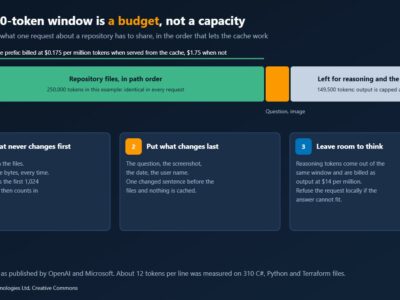
What OpenAI, Microsoft and GitHub have published about GPT-5.2-Codex, with sources, and what the 400,000-token window means in practice: how much code fits, what a session costs, and how prompt order decides whether caching applies.
Read more →