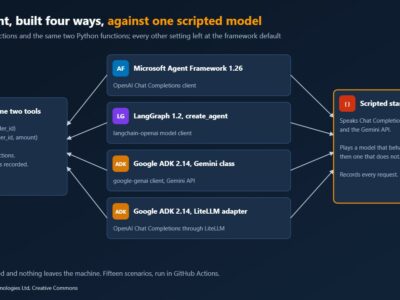
The same agent and the same two tools built with Microsoft Agent Framework, LangGraph and Google ADK, run against a scripted model that calls missing tools, sends wrong types, repeats a refund and never stops. The defaults differ, and a few lines of configuration bring them into line.
Read more →Tag: LLM
GPT-6 in Codex: Choosing Between Astra, Sol and Luna
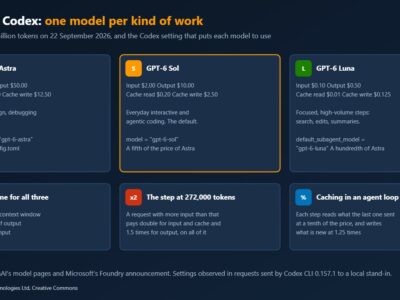
GPT-6 Astra, Sol and Luna are all in Codex and differ in price by a factor of a hundred. What has been published about them, what an agent session costs under the new caching and long-context rules, and what Codex CLI actually sends when each kind of work is given its own model.
Read more →RAG over FHIR Data on AWS HealthLake and Azure Health Data Services: Retrieval That Respects the Record
A FHIR record is a graph of coded, dated, status-bearing resources, not a document corpus. This article sets out a retrieval design for generative AI over FHIR data: FHIR search for exact questions, similarity search for notes, pinned allergies and medication, a hard partition by patient, and citations on every statement. Tested on synthetic data and mapped to AWS HealthLake and the Azure Health Data Services FHIR service.
Read more →Amazon S3 Vectors vs. OpenSearch Serverless vs. pgvector for RAG: Cost Floors, Query Bills and Tenant Isolation
All three AWS vector stores can now cost close to nothing at rest, but they bill and isolate tenants in very different ways. This comparison models Amazon S3 Vectors, OpenSearch Serverless (classic and next generation) and Aurora PostgreSQL with pgvector across three workload shapes, checks the S3 Vectors model against the worked examples on the AWS pricing page, and shows where the tenant boundary belongs in each.
Read more →Prompt Caching Economics on Amazon Bedrock and Azure OpenAI: Where It Pays and Where It Costs
Prompt caching cannot raise your bill on Azure OpenAI, but on Amazon Bedrock with Claude models a cache write costs more than not caching. This article derives the break-even points (one request per prefix every 20 minutes for the five-minute cache, every 80 minutes for the one-hour cache), gives a tested cost model, and shows how to measure cache read ratios on both platforms.
Read more →One Abstraction, Two Clouds: Microsoft.Extensions.AI over Azure OpenAI and Amazon Bedrock
Microsoft.Extensions.AI gives .NET services one interface over Azure OpenAI and Amazon Bedrock. This article builds a two-provider ASP.NET Core service with per-provider telemetry, caching, token metering, tool calling and failover, and is clear about where the abstraction stops: model identity, errors, content safety and model behaviour remain provider-specific.
Read more →