In my two decades of building enterprise systems, few architectural decisions have proven as consequential as API strategy. Azure API Management has evolved from a simple gateway into a comprehensive platform for managing the entire API lifecycle. Whether you’re exposing internal services to partners, building a developer ecosystem, or modernizing legacy systems through API facades, understanding APIM’s capabilities is essential for any Solutions Architect working in the Azure ecosystem.
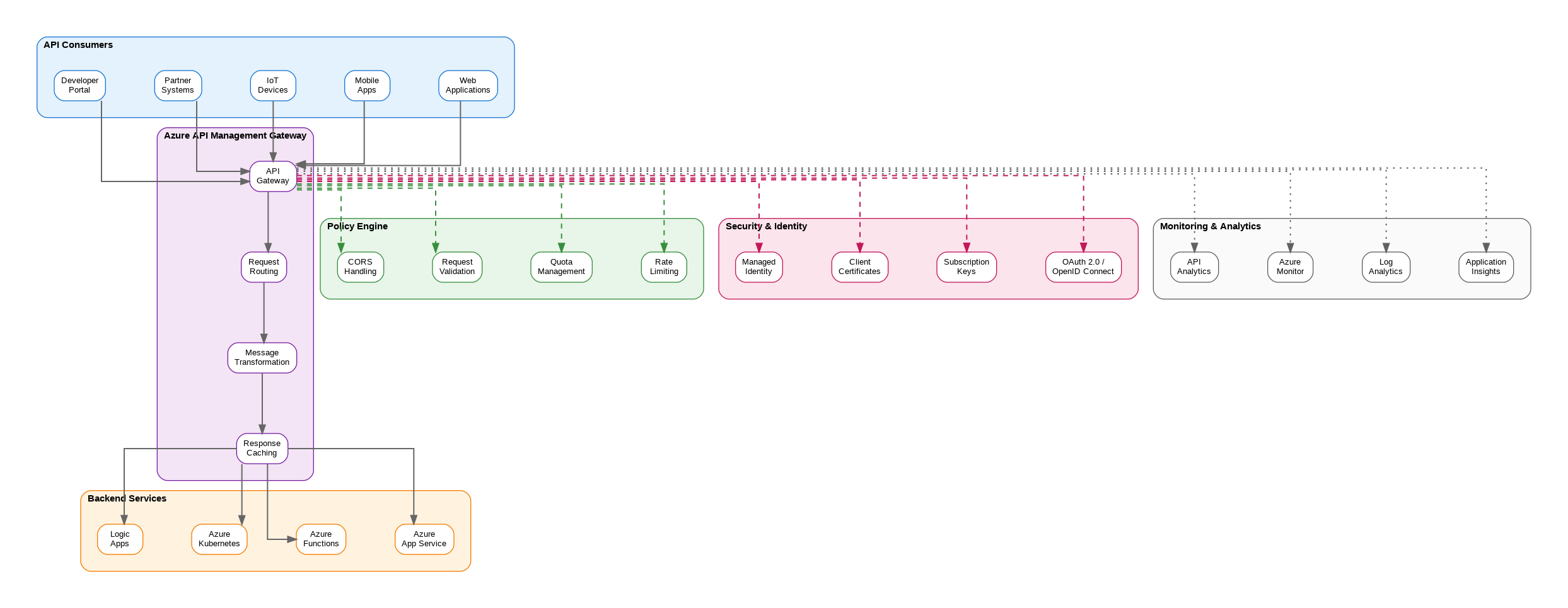
The API Gateway Pattern
At its core, Azure API Management implements the API Gateway pattern—a single entry point that sits between API consumers and your backend services. This architectural approach provides centralized authentication, rate limiting, request transformation, and monitoring. Rather than implementing these cross-cutting concerns in every service, you handle them once at the gateway layer.
The gateway abstracts your backend topology from consumers. You can refactor, migrate, or replace backend services without breaking client applications. I’ve used this capability extensively during cloud migrations, routing traffic between on-premises and cloud backends while maintaining a stable API contract for consumers.
Policy Engine: The Heart of APIM
APIM’s policy engine is where the real power lies. Policies are XML-based rules that execute at different stages of request processing: inbound (before reaching the backend), backend (when forwarding the request), outbound (before returning to the client), and on-error (when exceptions occur). This pipeline model gives you fine-grained control over every aspect of API behavior.
Common policy patterns include rate limiting to protect backends from abuse, request validation to enforce schemas, response caching to improve performance, and header transformation to adapt between different API versions. The policy expression language supports C# expressions, enabling complex conditional logic based on request context, user claims, or backend responses.
Security and Identity Integration
Enterprise API security requires multiple layers. APIM supports subscription keys for simple scenarios, OAuth 2.0 and OpenID Connect for delegated authorization, client certificates for mutual TLS, and integration with Azure Active Directory for enterprise identity. The validate-jwt policy can verify tokens from any compliant identity provider, extracting claims for use in downstream policies.
For backend authentication, Managed Identity eliminates credential management entirely. APIM authenticates to backend services using Azure AD tokens, with no secrets to rotate or store. This pattern significantly reduces the attack surface and operational burden of credential management.
Developer Portal and API Products
APIM includes a customizable developer portal where API consumers can discover APIs, read documentation, try APIs interactively, and manage their subscriptions. The portal supports OpenAPI specifications, automatically generating documentation and test consoles from your API definitions.
APIs are organized into Products—bundles of APIs with specific access policies, rate limits, and terms of use. This model supports tiered offerings: a free tier with strict rate limits for evaluation, a standard tier for production use, and a premium tier with higher limits and SLA guarantees. Products can require approval, enabling you to vet consumers before granting access.
Deployment Tiers: When to Use What
Choosing the right APIM tier depends on your requirements. The Consumption tier offers serverless pricing—you pay only for API calls with no minimum commitment. It’s ideal for development, testing, and low-volume production scenarios. However, it lacks some enterprise features like VNet integration and the developer portal.
The Developer tier provides full functionality at reduced cost for non-production use. The Basic and Standard tiers offer increasing capacity and SLA guarantees for production workloads. The Premium tier adds multi-region deployment, availability zones, and VNet integration for enterprise scenarios requiring high availability and network isolation.
For most enterprise deployments, I recommend starting with Standard tier for production APIs, using Developer tier for non-production environments, and considering Premium only when you need multi-region failover or strict network isolation requirements.
Backend Integration Patterns
APIM connects to diverse backend types: Azure App Service, Azure Functions, Azure Kubernetes Service, Logic Apps, and any HTTP endpoint including on-premises services through VNet integration or self-hosted gateways. The self-hosted gateway runs as a container in your environment, enabling APIM policies for APIs that can’t be exposed to the cloud.
Backend pools enable load balancing across multiple instances, with health probes detecting and routing around failures. Circuit breaker policies prevent cascade failures by temporarily stopping requests to unhealthy backends. These patterns are essential for building resilient API architectures.
Monitoring and Analytics
APIM integrates with Azure Monitor for metrics and alerts, Application Insights for distributed tracing, and Log Analytics for detailed request logging. Built-in analytics dashboards show API usage patterns, error rates, and performance metrics. This observability is crucial for capacity planning, troubleshooting, and understanding how consumers use your APIs.
Practical Implementation Tips
Version your APIs from day one using URL path versioning or header-based versioning. Use named values for configuration that varies between environments. Implement proper error handling policies that return consistent error formats without exposing internal details. Design policies for reusability using policy fragments.
Azure API Management has become the standard for enterprise API governance in Azure environments. Its combination of gateway capabilities, policy flexibility, developer experience, and enterprise security features makes it an essential component of modern cloud architectures. Whether you’re building internal APIs or public developer platforms, APIM provides the foundation for scalable, secure, and manageable API ecosystems.
Discover more from C4: Container, Code, Cloud & Context
Subscribe to get the latest posts sent to your email.