React Server Components represent the most significant architectural shift in React since hooks. By moving rendering logic to the server while maintaining React’s component model, RSC fundamentally changes how we think about data fetching, bundle sizes, and application performance.
Introduction
React Server Components (RSC) enable developers to build applications where components render on the server by default, with the option to mark specific components as client-side when interactivity is required. This hybrid approach delivers substantial performance improvements while maintaining the developer experience React is known for.
The key innovation is the ability to fetch data directly within components without waterfall requests, access server-side resources like databases and file systems, and dramatically reduce JavaScript bundle sizes by keeping server-only code off the client. For enterprise applications handling sensitive data, RSC provides architectural patterns that naturally align with security and compliance requirements.
This guide covers RSC architecture fundamentals, implementation patterns, and practical considerations for adopting this technology in production environments where performance, security, and maintainability are paramount.
Section 1: Understanding the RSC Architecture
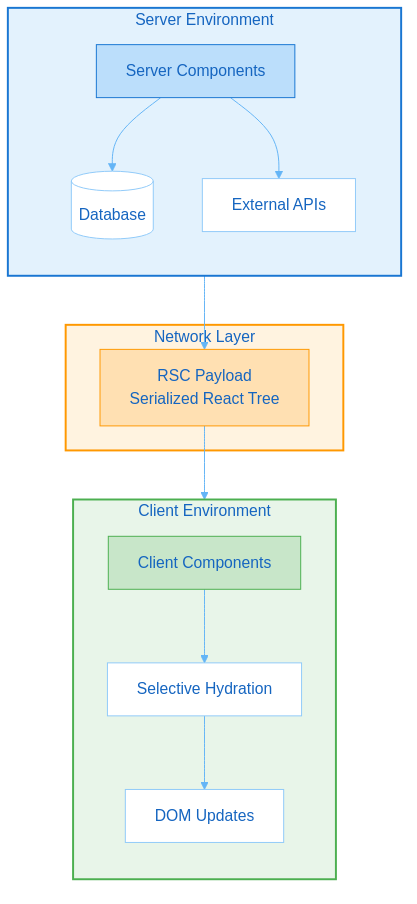
React Server Components introduce a new rendering paradigm that splits your application into server and client boundaries. Unlike traditional SSR where the entire application renders on the server and then hydrates on the client, RSC maintains a persistent server-client relationship where server components never ship JavaScript to the browser.
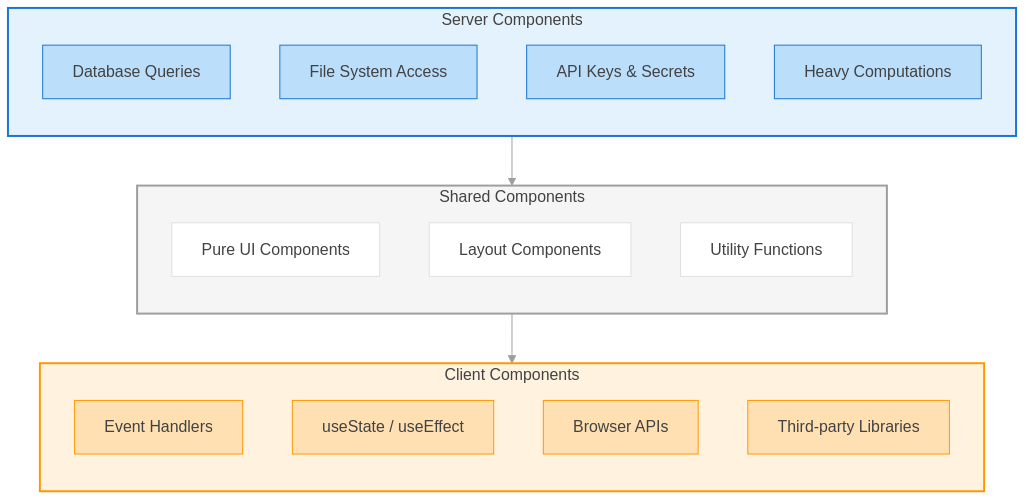
Server Components execute exclusively on the server, enabling direct database access, file system operations, and secure handling of API keys and secrets. They produce a serialized representation called the RSC Payload, which the client uses to construct the UI without needing the component’s source code.
Client Components are marked with the ‘use client’ directive and handle interactivity, browser APIs, and state management. The boundary between server and client components is explicit, making it clear where code executes and what gets shipped to the browser.
Section 2: Data Fetching Patterns and Best Practices
RSC transforms data fetching from an imperative, effect-based pattern to a declarative, component-based approach. Components can be async functions that await data directly, eliminating the need for useEffect, loading states management, and complex caching strategies in many cases.
For parallel data fetching, leverage Promise.all or React’s built-in request deduplication. The framework automatically batches and deduplicates identical requests, reducing database load and improving response times.
Implement proper error boundaries and Suspense boundaries to handle loading and error states gracefully. This pattern provides better user experience while keeping component logic clean and focused.
Section 3: Performance Optimization with Streaming
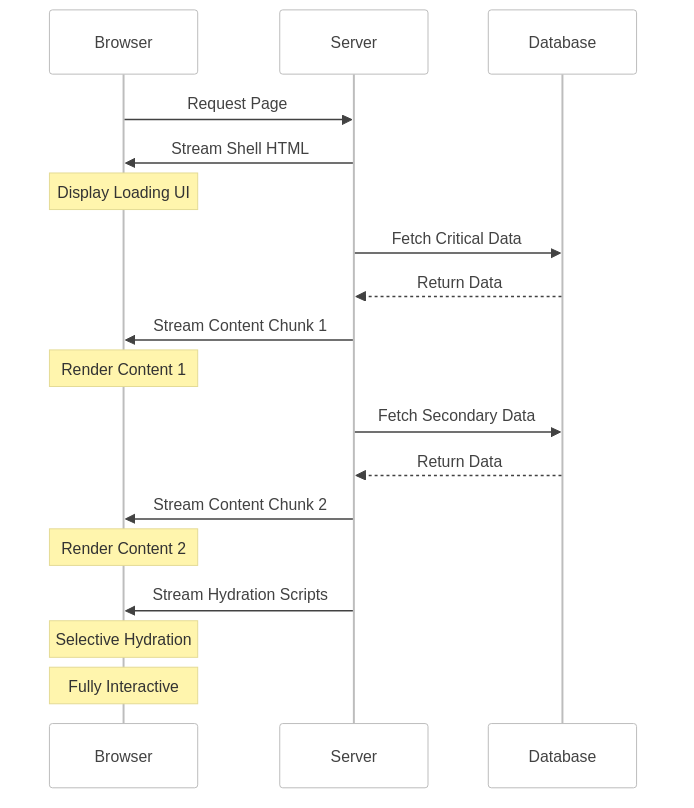
Streaming SSR with RSC enables progressive rendering where the browser receives and displays content as it becomes available. Instead of waiting for all data to load before sending any HTML, the server streams the shell immediately and fills in content as data resolves.
Each Suspense boundary enables independent streaming, so fast-loading components display immediately while slower ones show loading states. This dramatically improves perceived performance and Time to First Contentful Paint (FCP).
Section 4: Security and Compliance Considerations
RSC architecture provides natural security boundaries that align well with enterprise compliance requirements. Server Components never expose their source code or dependencies to the client, making it impossible for sensitive logic or credentials to leak to the browser.
For HIPAA-compliant healthcare applications, RSC enables patterns where Protected Health Information (PHI) is processed entirely on the server. Client components receive only the rendered output, never the raw data, reducing the attack surface significantly.
For PCI-DSS compliance in financial applications, sensitive operations like payment processing can be isolated in Server Components, ensuring card data never touches client-side JavaScript. Combined with proper network segmentation and encryption, this architecture simplifies compliance audits.
Diagrams & Infographics
The following diagrams illustrate the key architectural concepts of React Server Components.

Technology Recommendations
Framework Selection: When to Use What
Next.js App Router: The most mature RSC implementation, recommended for new projects. Provides excellent developer experience, built-in optimizations, and strong community support. Cost-effective for most use cases due to Vercel’s generous free tier and efficient edge deployment.
Remix: Excellent alternative with a different philosophy focused on web standards. Better choice when you need fine-grained control over HTTP responses, prefer loader/action patterns, or have existing Express/Node infrastructure.
Prisma: Recommended for most RSC applications. Type-safe queries, excellent developer experience, and seamless integration with Server Components.
Drizzle ORM: Lighter alternative when bundle size is critical or you prefer SQL-like syntax. Better performance characteristics for high-throughput applications.
Cost, Scalability & Security Considerations
Cost Drivers
RSC applications typically reduce client-side JavaScript by 30-70%, directly lowering CDN bandwidth costs. However, server compute costs increase as more rendering happens server-side. For read-heavy applications with good caching strategies, the net effect is usually cost-positive.
Scalability Patterns
RSC applications scale horizontally through standard container orchestration (Kubernetes, ECS). Implement proper caching at multiple levels: CDN for static assets, Redis for session data, and database query caching for frequently accessed data.
Security Architecture
RSC provides defense-in-depth by default. Server Components cannot be inspected or manipulated by clients, API keys and database credentials stay on the server, and the attack surface is reduced to the explicit client component boundaries.
Key Takeaways
- RSC fundamentally changes React architecture by enabling server-side data fetching within components, reducing bundle sizes, and providing natural security boundaries.
- Streaming SSR with Suspense boundaries enables progressive rendering that dramatically improves perceived performance and Core Web Vitals scores.
- The server-client boundary is explicit and intentional, making it easier to reason about security, performance, and compliance requirements.
Next Steps
- Start with a new Next.js 14+ project using the App Router to experience RSC patterns firsthand.
- Identify components in your current applications that would benefit from server-side rendering.
- Establish clear guidelines for your team on when to use Server vs Client Components.
References & Further Reading
- React Labs: What We’ve Been Working On
- Next.js Server Components Documentation
- Patterns.dev: React Server Components
- React Server Components Working Group
Call to Action
Ready to modernize your React architecture with Server Components? Start by creating a proof-of-concept with Next.js App Router and measure the impact on your bundle size and performance metrics. Share your migration experiences and architectural decisions in the comments below.
Discover more from C4: Container, Code, Cloud & Context
Subscribe to get the latest posts sent to your email.