Something remarkable is happening in frontend development. After years of framework fatigue and build tool complexity, we’re witnessing a genuine renaissance—a convergence of mature tooling, refined patterns, and developer experience improvements that’s fundamentally changing how we build web applications. Having spent over two decades watching frontend evolution from table-based layouts to the current ecosystem, I can say with confidence that 2025 represents a genuine inflection point.
The Framework Maturity Moment
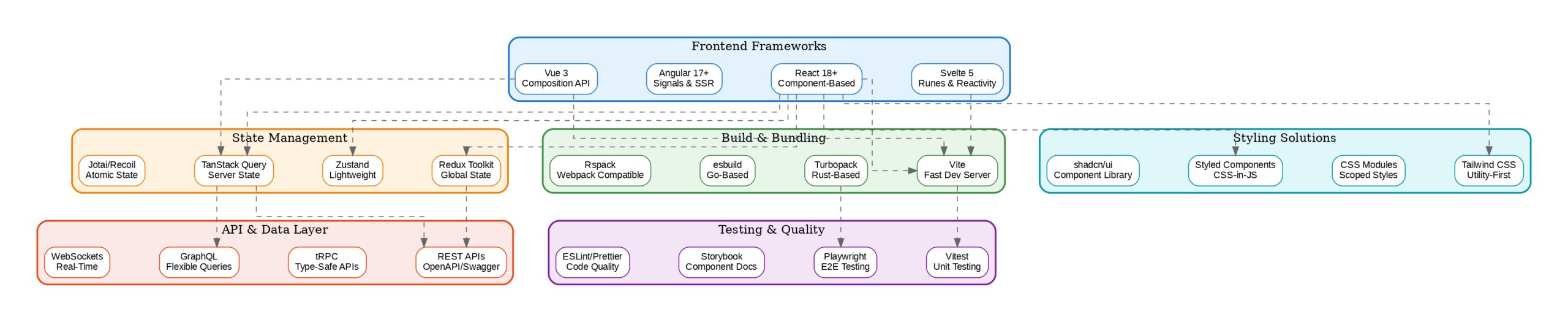
The major frameworks have reached a level of maturity that was unimaginable just a few years ago. React 18+ with its concurrent features, Vue 3’s Composition API, Angular 17’s signals and improved SSR, and Svelte 5’s revolutionary runes system—each represents years of refinement rather than disruptive reinvention. This stability matters enormously for enterprise adoption and long-term project sustainability.
What’s particularly notable is how these frameworks have converged on similar solutions to common problems. Server components, fine-grained reactivity, and improved hydration strategies appear across the ecosystem. This convergence isn’t a sign of stagnation—it’s evidence that the community has collectively discovered effective patterns through years of production experience.
The Build Tool Revolution
Perhaps the most dramatic improvement has been in build tooling. Vite has fundamentally changed developer expectations around startup time and hot module replacement. The shift from JavaScript-based bundlers to Rust and Go-based alternatives like Turbopack, esbuild, and Rspack has delivered order-of-magnitude performance improvements. A project that once took 30 seconds to start now launches in under a second.
This isn’t just about developer convenience—though that matters. Faster feedback loops fundamentally change how developers work. When rebuilds are instant, experimentation becomes natural. When the development server starts immediately, context switching costs disappear. These seemingly small improvements compound into significant productivity gains across teams.
State Management: The Great Simplification
The state management landscape has undergone a quiet revolution. The era of boilerplate-heavy solutions is giving way to more pragmatic approaches. TanStack Query has transformed how we think about server state, making cache invalidation and optimistic updates straightforward. Zustand and Jotai offer lightweight alternatives to Redux for client state, while Redux Toolkit has dramatically reduced the ceremony required for complex state management.
The key insight driving this simplification is the recognition that server state and client state are fundamentally different concerns requiring different solutions. By separating these concerns, modern applications achieve cleaner architectures with less code.
Styling Solutions That Actually Work
Tailwind CSS has proven that utility-first CSS isn’t just viable—it’s often preferable for team productivity. The combination of Tailwind with component libraries like shadcn/ui has created a new paradigm where developers can build polished interfaces rapidly without sacrificing customization. Meanwhile, CSS-in-JS solutions continue to evolve, and CSS Modules remain a solid choice for teams preferring traditional approaches.
The real victory here is that teams now have genuinely good options across the spectrum. Whether you prefer utility classes, scoped CSS, or CSS-in-JS, mature solutions exist that won’t paint you into a corner.
Testing and Quality: Finally Solved
Vitest has brought the speed and developer experience improvements of Vite to unit testing. Playwright has made end-to-end testing reliable and maintainable. Storybook has evolved into a comprehensive component documentation and testing platform. The combination of these tools means that comprehensive testing is no longer a burden—it’s a natural part of the development workflow.
ESLint and Prettier have become so standard that code formatting debates are largely settled. TypeScript adoption has reached the point where type safety is the default expectation rather than an optional enhancement.
The API Layer Evolution
The relationship between frontend and backend continues to evolve. tRPC has demonstrated that end-to-end type safety is achievable without the overhead of traditional API contracts. GraphQL remains powerful for complex data requirements, while REST APIs with OpenAPI specifications provide a solid foundation for many applications. WebSockets and Server-Sent Events enable real-time features that users increasingly expect.
Practical Recommendations
For teams starting new projects in 2025, my recommendations are straightforward. Choose a framework based on your team’s experience and project requirements—all major options are production-ready. Use Vite or a Vite-based meta-framework for development tooling. Adopt TypeScript from day one. Implement TanStack Query for server state management. Consider Tailwind CSS for styling, especially if rapid iteration is important.
For existing projects, the path forward is incremental adoption. Modern tools are designed to coexist with legacy code. Migrate build tooling first for immediate developer experience improvements. Introduce TypeScript gradually. Adopt new patterns in new features while maintaining existing code.
Looking Forward
The frontend renaissance isn’t about any single technology—it’s about the ecosystem reaching a level of maturity where building excellent web applications is genuinely enjoyable. The tools work. The patterns are proven. The community has accumulated enough collective wisdom to guide newcomers effectively.
For those of us who remember the early days of web development, this moment feels significant. We’ve moved from an era of constant churn to one of refinement and optimization. The fundamentals are settled; now we can focus on building great products rather than fighting our tools.
The frontend renaissance is here, and it’s a great time to be building for the web.
Discover more from C4: Container, Code, Cloud & Context
Subscribe to get the latest posts sent to your email.