Something fundamental shifted in frontend development in 2024, and most developers are still catching up. React Server Components (RSC) represent the most significant architectural change to React since hooks, fundamentally rethinking where code executes and how data flows through modern web applications. After building production systems with RSC for the past year, I’ve come to believe this isn’t just another framework feature—it’s a paradigm shift that will define how we build web applications for the next decade.
The Problem RSC Actually Solves
Traditional React applications ship JavaScript to the browser, fetch data, then render. This creates a waterfall: HTML loads, JavaScript downloads, React hydrates, data fetches, and finally the user sees content. Server-side rendering (SSR) helped by sending initial HTML, but you still shipped the same JavaScript bundle and hydrated the entire component tree. React Server Components eliminate this fundamental inefficiency by keeping server-only code on the server—permanently.
The key insight is that many components don’t need interactivity. A blog post, a product description, a navigation menu—these render once and never change based on user input. Why ship JavaScript for components that will never re-render? RSC lets you write these as Server Components that execute on the server, send HTML to the client, and never touch the browser’s JavaScript runtime.
The Mental Model Shift
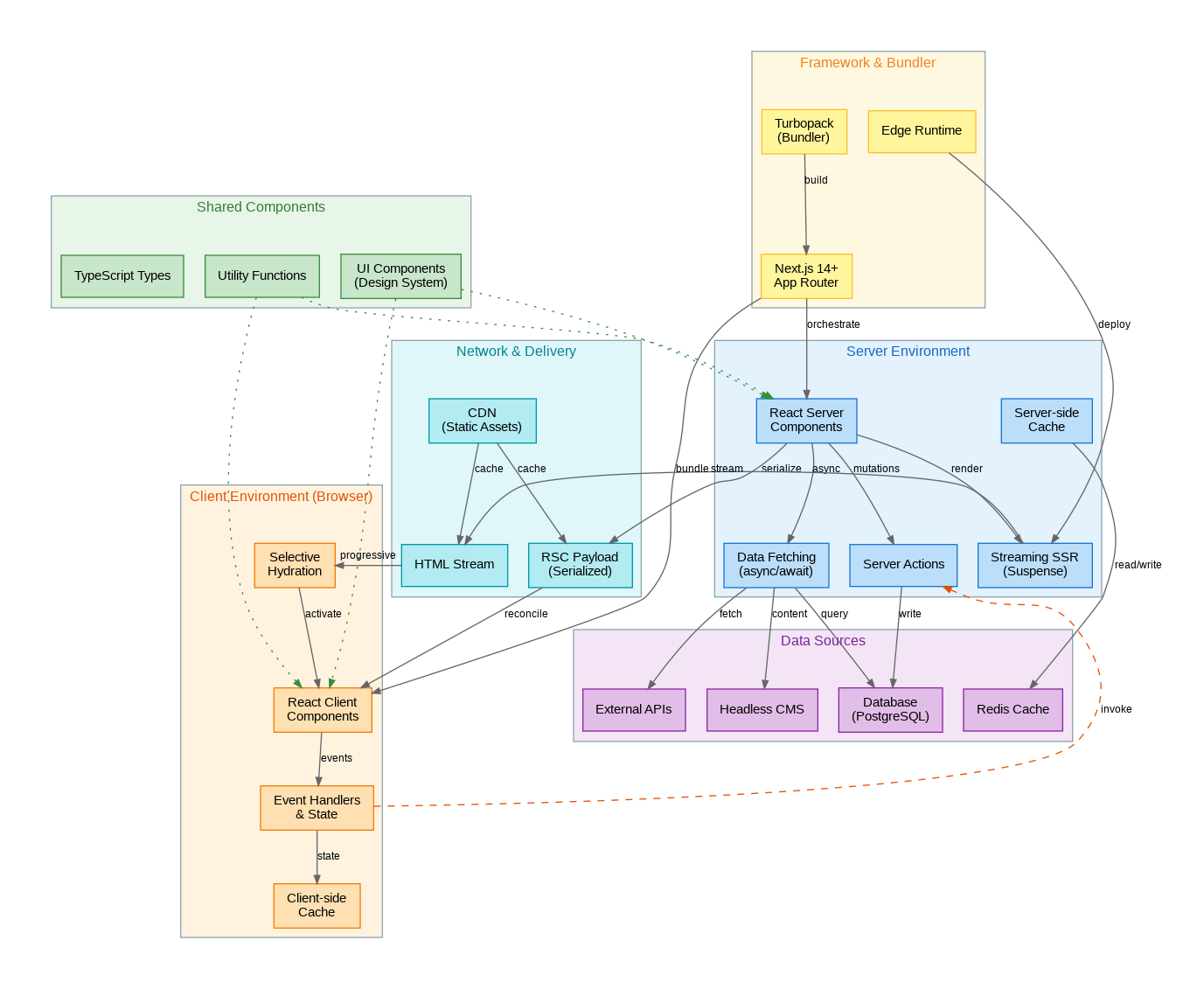
Understanding RSC requires abandoning the mental model where React equals client-side JavaScript. In the RSC world, you have two types of components: Server Components (the default) that run only on the server, and Client Components (marked with ‘use client’) that run on both server and client. Server Components can directly access databases, file systems, and backend services. They can use async/await at the component level. They never ship to the browser.
This creates a new architecture pattern I call the “server-client boundary.” You structure your application with Server Components at the top of the tree, handling data fetching and business logic, while Client Components handle interactivity at the leaves. The boundary between them is explicit and intentional, not an afterthought.
Real Performance Gains
In production applications I’ve migrated to RSC, the results are striking. JavaScript bundle sizes dropped 40-60% because server-only dependencies like database clients, markdown parsers, and date formatting libraries never reach the browser. Time to Interactive improved significantly because there’s less JavaScript to parse and execute. But the most dramatic improvement was in perceived performance—pages feel instant because content streams to the browser as it’s generated.
Streaming SSR with RSC changes the user experience fundamentally. Instead of waiting for all data before showing anything, the server sends HTML progressively. The shell renders immediately, then content fills in as database queries complete. Users see a fast, responsive application even when backend operations take time.
The Composition Challenge
The trickiest aspect of RSC is component composition. Server Components can render Client Components, but Client Components cannot import Server Components directly. This constraint forces you to think carefully about where interactivity lives. The pattern that works best is passing Server Components as children to Client Components—the server renders the Server Component, and the Client Component receives it as already-rendered content.
This leads to cleaner architecture. Interactive wrappers (modals, tabs, accordions) become thin Client Components that manage state, while the content inside them remains Server Components with direct data access. You end up with better separation of concerns than traditional React applications.
Data Fetching Revolution
RSC eliminates the need for most data fetching libraries. No more useEffect for fetching, no more loading states managed in component state, no more client-side caching strategies. Server Components fetch data directly using async/await, and the data is already there when the component renders. Combined with React’s built-in caching and deduplication, you get efficient data fetching without the complexity of libraries like React Query or SWR for server data.
Server Actions complement this by providing a type-safe way to mutate data. Instead of building API routes, you define functions that run on the server and call them from Client Components. The framework handles serialization, error handling, and revalidation. It’s a return to the simplicity of traditional server-rendered applications, but with React’s component model.
When to Use What
After extensive production experience, here’s my decision framework: Use Server Components for anything that doesn’t need browser APIs or user interaction—data display, layouts, navigation, content pages. Use Client Components for forms, interactive widgets, anything using useState or useEffect, and components that need browser APIs like localStorage or geolocation. When in doubt, start with a Server Component and add ‘use client’ only when you hit a limitation.
The framework choice matters too. Next.js 14+ with the App Router provides the most mature RSC implementation. Remix is exploring RSC integration. For greenfield projects, Next.js App Router is my recommendation. For existing applications, the migration path requires careful planning—you can’t just add RSC to a Create React App project.
The Ecosystem Adaptation
The React ecosystem is still adapting to RSC. Many popular libraries assume client-side execution and break in Server Components. CSS-in-JS solutions like styled-components required significant rewrites. State management libraries are rethinking their APIs. This transition period is painful but temporary—the ecosystem is converging on RSC-compatible patterns.
Testing strategies also need updating. Server Components can be tested like regular async functions—no need for render utilities or DOM assertions. Client Components still use React Testing Library. The separation actually makes testing easier once you adapt your approach.
Looking Forward
React Server Components represent React’s answer to the performance and complexity challenges of modern web development. They’re not a silver bullet—the learning curve is real, and the ecosystem is still maturing. But for teams building content-heavy applications, e-commerce sites, or any application where performance matters, RSC provides architectural patterns that were previously impossible in React.
The frontend landscape is shifting. Server Components, combined with streaming SSR and Server Actions, create a development experience that combines the best of traditional server-rendered applications with React’s component model. Teams that master these patterns now will have a significant advantage as RSC becomes the default way to build React applications.
Discover more from C4: Container, Code, Cloud & Context
Subscribe to get the latest posts sent to your email.