The debate between monolithic and microservices architectures has evolved significantly over the past decade. What was once a straightforward “microservices are better” narrative has matured into a nuanced understanding that the right architecture depends entirely on context. After leading architecture decisions across dozens of enterprise systems, I’ve learned that the most expensive mistakes come not from choosing the wrong technology, but from choosing the wrong architectural style for the problem at hand.
The Monolith Isn’t Dead
The industry’s rush toward microservices created a generation of over-engineered systems. Teams decomposed applications into dozens of services before they understood their domain boundaries, resulting in distributed monoliths—systems with all the complexity of microservices and none of the benefits. The monolith, properly designed, remains a powerful and appropriate choice for many scenarios.
A well-structured monolith offers significant advantages: simpler deployment, easier debugging, straightforward transaction management, and lower operational overhead. For teams smaller than 20 developers working on a single product, the monolith often delivers faster time to market and lower total cost of ownership. The key is building a modular monolith—one with clear internal boundaries that could be decomposed later if needed.
When Microservices Make Sense
Microservices shine when you have multiple teams that need to deploy independently, when different parts of your system have dramatically different scaling requirements, or when you’re building a platform that will evolve over many years with changing requirements. The organizational benefits—team autonomy, independent deployment, technology flexibility—often matter more than the technical benefits.
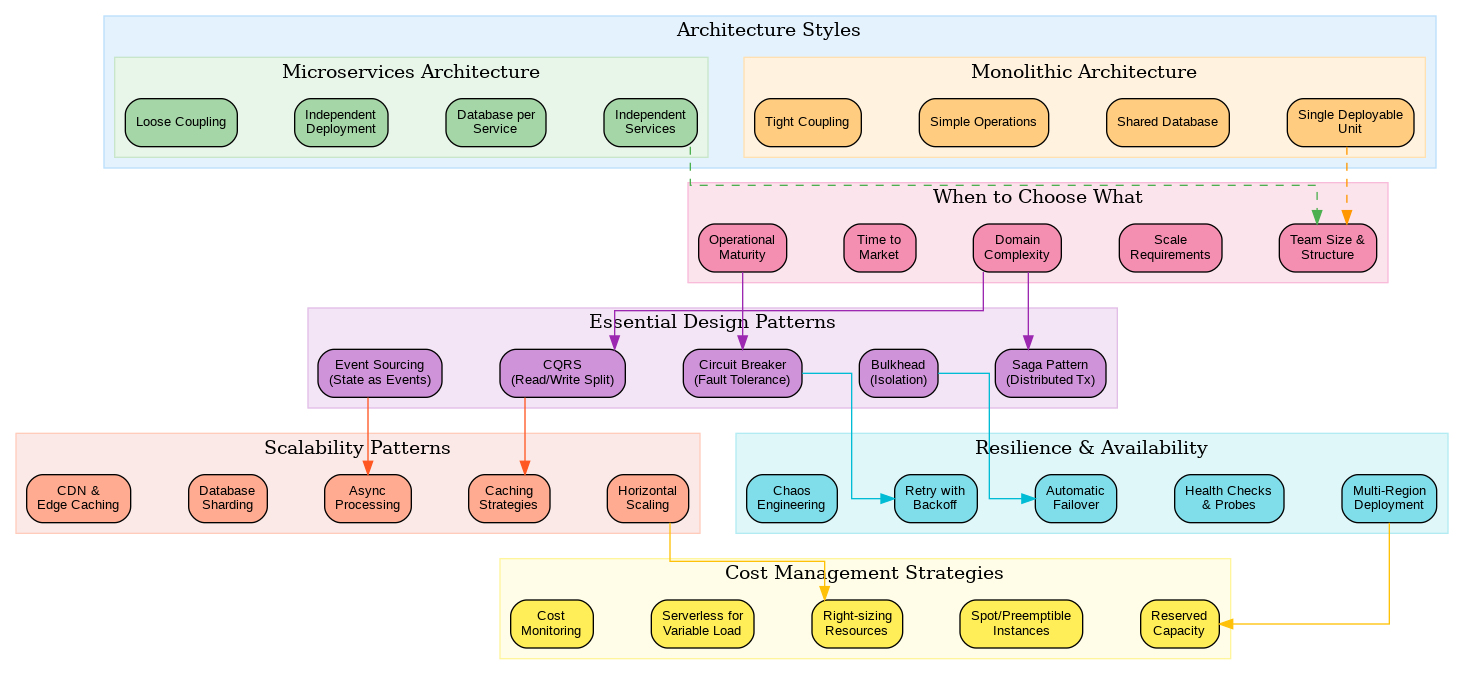
The decision framework I use considers five factors: team size and structure, scale requirements, domain complexity, time to market pressure, and operational maturity. A startup with five engineers building an MVP should almost never start with microservices. An enterprise with 200 engineers building a platform that will run for a decade probably should.
Essential Design Patterns for Distributed Systems
Regardless of which architectural style you choose, certain patterns become essential as systems grow. The Saga pattern handles distributed transactions by breaking them into a sequence of local transactions with compensating actions for rollback. CQRS (Command Query Responsibility Segregation) separates read and write models, enabling independent scaling and optimization. Event Sourcing stores state as a sequence of events, providing complete audit trails and enabling temporal queries.
For resilience, the Circuit Breaker pattern prevents cascade failures by failing fast when downstream services are unhealthy. The Bulkhead pattern isolates failures by partitioning resources, ensuring that problems in one area don’t bring down the entire system. These patterns apply whether you’re building a modular monolith or a microservices architecture.
Cost Management Strategies
Architecture decisions have profound cost implications. Microservices typically cost more to operate—more infrastructure, more monitoring, more coordination overhead. But they can reduce costs at scale by enabling precise resource allocation and independent scaling.
Effective cost management requires right-sizing resources based on actual usage patterns, leveraging spot or preemptible instances for fault-tolerant workloads, using reserved capacity for predictable baseline load, and adopting serverless for highly variable workloads. The key is matching your infrastructure strategy to your workload characteristics, not blindly following industry trends.
Building for Resilience
Resilience isn’t a feature you add later—it’s a property that emerges from architectural decisions made early. Multi-region deployment provides geographic redundancy but adds complexity and cost. Health checks and probes enable automatic detection of unhealthy instances. Retry with exponential backoff handles transient failures gracefully. Automatic failover ensures continuity when primary resources fail.
Chaos engineering—deliberately injecting failures to test resilience—has become essential for systems that must maintain high availability. Netflix’s Chaos Monkey pioneered this approach, and tools like Gremlin and LitmusChaos have made it accessible to any organization. The goal isn’t to prevent all failures, but to ensure that failures don’t cascade into outages.
Scalability Patterns
Horizontal scaling—adding more instances rather than bigger instances—provides better cost efficiency and resilience than vertical scaling. But horizontal scaling requires stateless services, externalized session state, and careful attention to data consistency.
Caching strategies dramatically improve performance and reduce load on backend systems. The cache-aside pattern loads data into cache on demand. Write-through caching ensures cache consistency at the cost of write latency. CDN and edge caching bring content closer to users, reducing latency and backend load.
Asynchronous processing decouples request handling from time-consuming operations. Message queues enable reliable communication between services. Event-driven architectures allow systems to react to changes without tight coupling. Database sharding distributes data across multiple instances, enabling horizontal scaling of data storage.
Making the Decision
The architecture decision should be driven by your specific context, not by industry hype. Start with these questions: How large is your team, and how is it organized? What are your scaling requirements—both current and projected? How complex is your domain, and how well do you understand it? What’s your time to market pressure? How mature is your operational capability?
For most new projects, I recommend starting with a modular monolith. Design clear boundaries between modules, use dependency injection to manage coupling, and ensure that modules communicate through well-defined interfaces. This approach gives you the simplicity of a monolith with the option to extract services later when—and if—you need to.
The Path Forward
Architecture is not a one-time decision but an ongoing evolution. The best architectures are those that can adapt as requirements change, teams grow, and understanding deepens. Whether you choose a monolith or microservices, invest in the fundamentals: clear boundaries, loose coupling, automated testing, and operational excellence.
The goal isn’t to build the most sophisticated architecture—it’s to build the right architecture for your context. Sometimes that’s a simple monolith. Sometimes it’s a complex microservices ecosystem. The wisdom lies in knowing which is which.
Discover more from C4: Container, Code, Cloud & Context
Subscribe to get the latest posts sent to your email.