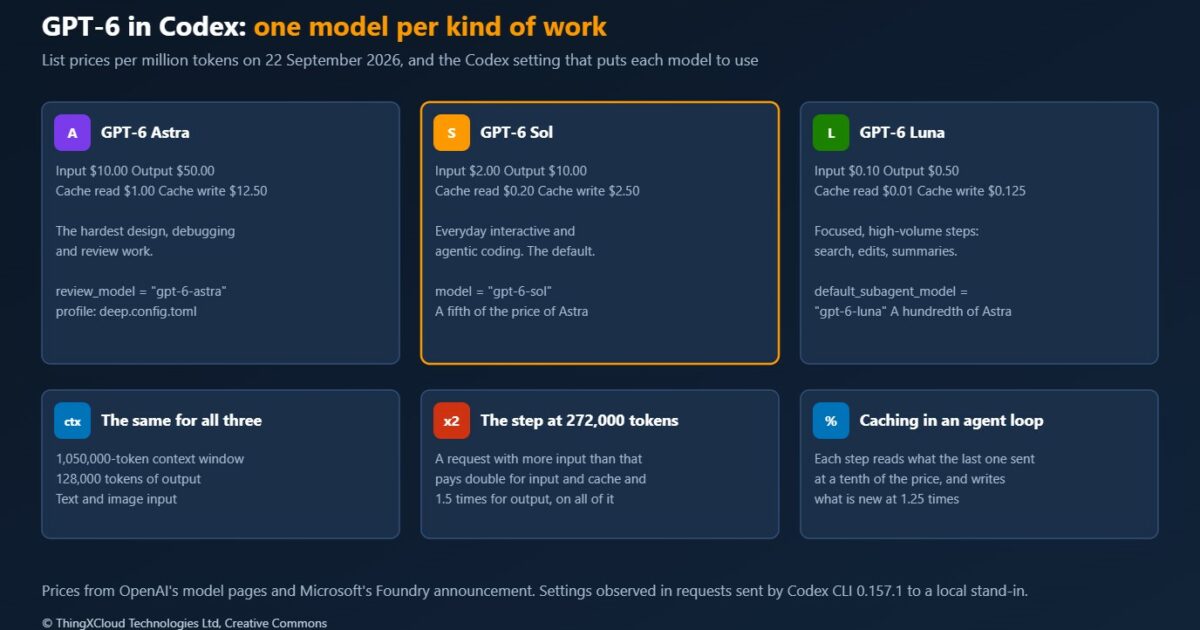
On Tuesday OpenAI released GPT-6 Sol and GPT-6 Luna, nearly three weeks after GPT-6 Astra. With that the GPT-6 family has a model at each price point, and all three are in Codex, in the API, in Microsoft Foundry and in GitHub Copilot. For a team that uses a coding agent every day, the question has changed. It is no longer which model to use. It is which model to use for which part of the work, because the three differ in price by a factor of a hundred and Codex can now be told to use different ones for planning, for delegated steps and for review.
This article sets out what has been published about the three models, with a source beside each figure. It then does two things an architect can check: it works out from the price list what an agent session costs and what changes that cost, and it gives a Codex configuration that assigns one model to each kind of work, and runs the Codex CLI with that configuration against a local stand-in for the API to see what the CLI really sends. The February article on GPT-5.2-Codex and the June article on prompt caching economics cover the ground before this release; several rules have changed since.
Facts about the models come from OpenAI’s changelog and model pages, Microsoft’s and GitHub’s announcements, and the Codex release notes, each linked where it is used. Benchmark figures are OpenAI’s own, quoted from press coverage of its launch posts, and are marked as such. The cost figures are arithmetic on list prices for modelled sessions whose token counts are assumptions. Codex CLI 0.157.1 was run for real, against a local stand-in that plays a script and reaches no model. So the article shows what Codex sends and how it is priced, and nothing about how well any of the three models writes code.
The timeline
| Date | What happened | Source |
|---|---|---|
| 9 July 2026 | GPT-5.6 family released, with explicit prompt caching controls | OpenAI API changelog |
| 3 September | GPT-6 Astra released. Reasoning effort can be changed mid-conversation without losing the cached prefix. Codex CLI 0.153.0 ships the same day | OpenAI API changelog, Codex release notes |
| 8 September | Prompt Cache Diagnostics generally available in the Responses API | OpenAI API changelog |
| 22 September | GPT-6 Sol and GPT-6 Luna released in the API, Codex and ChatGPT. Generally available in Microsoft Foundry and rolling out in GitHub Copilot the same day. Codex CLI 0.156.0 | OpenAI announcement, Microsoft, GitHub, Codex release notes |
| 25 September | Fix for an image-encoding bug that degraded image understanding in Sol and Luna | OpenAI API changelog |
What has been published
| Property | Astra | Sol | Luna | Source |
|---|---|---|---|---|
| Positioning | Most capable, for the most demanding work | Complex coding and agentic workflows | Most efficient, for focused high-volume tasks | model pages (OpenAI) |
| Input, per million tokens | $10.00 | $2.00 | $0.10 | Microsoft Foundry announcement |
| Cache read | $1.00 | $0.20 | $0.01 | Microsoft Foundry announcement |
| Cache write | $12.50 | $2.50 | $0.125 | Microsoft Foundry announcement |
| Output | $50.00 | $10.00 | $0.50 | Microsoft Foundry announcement |
| Context window and output | 1,050,000 and 128,000 tokens | the same | the same | OpenAI model pages |
| Long-context rule | Over 272,000 input tokens: input and cache at 2x, output at 1.5x, for the whole request | the same | the same | OpenAI model pages |
| Reasoning effort | low to max | none to max, default medium | none to max, default medium | OpenAI model pages |
| Input and output | Text and images in, text out | the same | the same | OpenAI model pages |
| Knowledge cutoff | 30 April 2026 | 20 April 2026 | 18 May 2026 | OpenAI model pages |
| Processing options | Batch and Flex at half price, Fast mode at double | the same | the same | OpenAI model pages |
| Codex | All three are selectable. Sol and Luna for Plus, Pro, Business, Enterprise and Edu; Enterprise administrators enable them | OpenAI announcement, 9to5Mac | ||
| GitHub Copilot | Released earlier | Pro+, Max, Business, Enterprise | Pro and above; usage-based billing | GitHub changelog |
| Microsoft Foundry | Standard and Provisioned | Standard, Provisioned and Priority; generally available | Standard; generally available | Microsoft Foundry announcement |
OpenAI says the Sol and Luna prices are half the promotional prices of their GPT-5.6 counterparts and that the cut is permanent, made possible by cheaper caching and inference. It also says both use fewer tokens for the same work than the GPT-5.6 models of their class.
On quality there are only OpenAI’s own numbers so far, and they are about more than coding. As reported from its launch posts: Astra scores 72.6% on OSWorld 2.0, 57.7% on Terminal-Bench 4.0 and 74.1% on DeepSWE v1.1 (DataCamp); Sol at its highest effort scores 60.5% on OSWorld 2.0, and OpenAI describes Astra as still its best model for computer use (9to5Mac). None of these says how each model does on your repository. A community run on the announcement thread had all three of a small set of coding tasks passing on both Sol and Luna, with Luna at a tenth of Sol’s cost or less; treat it as an anecdote and run your own.
Architecture: where the model is chosen
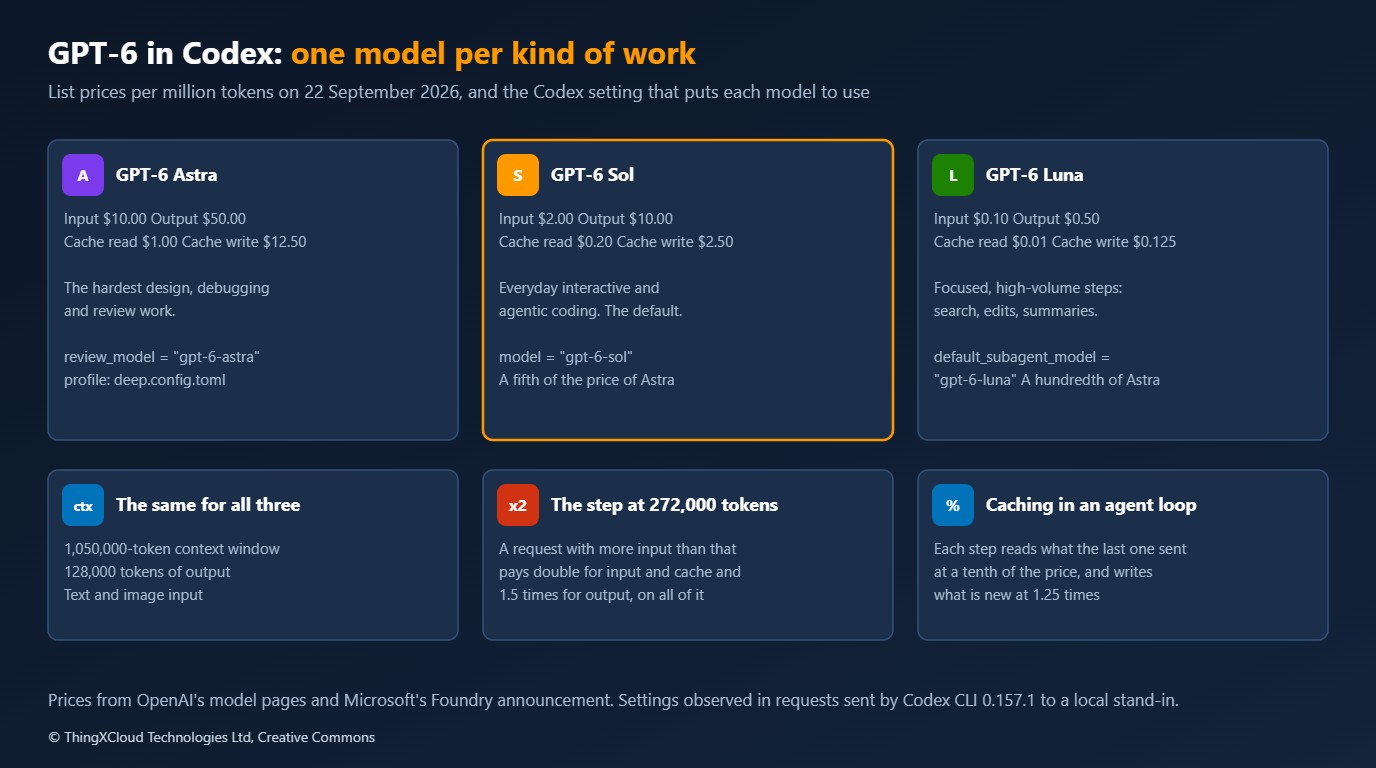
A coding agent does not make one kind of request. In a single piece of work it plans, runs many small steps (read a file, run a test, apply an edit), may hand parts to subagents, and at the end reviews what changed. Codex exposes a separate setting for each of those, so the choice of model is a routing decision, made in configuration.
%%{init: {'theme':'base','themeVariables':{'primaryColor':'#FFF3E0','primaryTextColor':'#232F3E','primaryBorderColor':'#FF9900','lineColor':'#232F3E','clusterBkg':'#F8FAFC','clusterBorder':'#CBD5E1','edgeLabelBackground':'#FFFFFF','nodeTextColor':'#232F3E'}}}%%
flowchart TD
    T["A task for Codex"] --> P["Plan
model, plan_mode_reasoning_effort"]
    P --> M["Main session
model, model_reasoning_effort"]
    M --> S["Subagents for delegated steps
agents.default_subagent_model"]
    S --> M
    M --> R["Review of the change
review_model"]
    R --> H["Human approval
and the usual pull-request gates"]
    style M fill:#FFF3E0,stroke:#FF9900,stroke-width:2px,color:#232F3E
    style S fill:#F0FFF4,stroke:#1D8102,stroke-width:2px,color:#145202
    style R fill:#F3E8FF,stroke:#7C3AED,stroke-width:2px,color:#4C1D95
style H fill:#EBF8FF,stroke:#0073BB,stroke-width:2px,color:#004C74| Option | Advantages | Disadvantages and risks | Cost and operations |
|---|---|---|---|
| One model for everything, the most capable | Nothing to tune. Best chance on hard problems | Pays the top price for reading files and running tests. Usage limits are reached sooner | Highest by a wide margin |
| One mid-range model for everything | Simple. A sound default | No extra scrutiny at review. Bulk work still costs more than it needs to | A fifth of the first option at list prices |
| A model per role | Each step is priced for what it needs. An independent, stronger reviewer | More configuration to own. A weak worker can produce plausible, wrong changes that the review must catch | Lowest for the same work, if the work still gets done |
| The cheapest model for everything | Very low cost, high limits | Most likely to fail on multi-step reasoning. Failures cost engineer time, which is not on the token bill | Lowest on paper |
Three rules in the price list
Three rules decide most of what an agent session costs, and two of them are new since the GPT-5 models.
- Cache reads cost a tenth of the input price. This is as before.
- Cache writes cost 1.25 times the input price. On these models a token written to the cache is billed at the write rate in place of the input rate. In the default mode the service places a cache breakpoint at the end of the latest message, so the new part of every request is a write. Earlier models had no write charge.
- A request with more than 272,000 input tokens costs double. Input and cache rates are multiplied by two and output by one and a half, and the multiplier applies to the whole request, not to the part above the line. The context window is 1,050,000 tokens; the price list changes at about a quarter of it.
The cost of one request, with those rules, is a few lines.
    def request(self, model: str, uncached: int, read: int, written: int, output: int, processing: str = "standard") -> float:
        """Dollars for one request. The three input figures are disjoint and add up to the prompt."""
        prices = self.models[model]
        long = uncached + read + written > self.long_context_over
        input_cost = (uncached * prices.input + read * prices.cache_read + written * prices.cache_write) * (self.long_input_multiplier if long else 1)
        output_cost = output * prices.output * (self.long_output_multiplier if long else 1)
        return (input_cost + output_cost) * self.processing[processing] / 1_000_000
== 1. One request: 100,000 tokens in, 5,000 out
model no caching cache written cache read
gpt-6-astra 1.2500$ 1.5000$ 0.3500$
gpt-6-sol 0.2500$ 0.3000$ 0.0700$
gpt-6-luna 0.0125$ 0.0150$ 0.0035$
ok Astra: $1.25 plain, $1.50 when the prompt is written to the cache, $0.35 when it is read from it
ok Sol is a fifth of Astra and Luna a hundredth, on every line
caching stops paying when more than 78.3% of prompt tokens are writes; the same for all three models
ok the break-even share of writes is 78.3% for every model
ok 200,000 tokens on Sol, written once and read once, cost $0.54; sent twice without caching they cost $0.80Two consequences follow. A prompt that is written to the cache and never read again costs 25% more than if caching had not been involved. For a one-off request with a large prompt, the API’s explicit cache mode with no breakpoint set avoids the write. And as soon as a prompt is read once, caching is ahead: written once and read once costs 1.35 times the input price against 2. Caching only loses when more than 78% of prompt tokens are writes, which an agent loop is nowhere near.
== 2. The step at 272,000 input tokens
gpt-6-sol, 272,000 tokens in (262,000 read, 10,000 written), 4,000 out   $0.1174
gpt-6-sol, 273,000 tokens in (263,000 read, 10,000 written), 4,000 out   $0.2152
ok    one thousand more tokens of context takes the request from $0.1174 to $0.2152
The second rule is a step, not a slope. A thousand tokens of extra context nearly doubles the price of that request and of every later request in the session.
What an agent session costs
An agent loop sends the whole conversation with every step: the instructions and tool definitions, then every tool call and result so far. The sample models that as a fixed base and a context that grows by a constant amount per step. With caching, each step reads what the previous step sent and writes what is new.
    history = 0
    cached = 0
    result: list[Turn] = []
    for number in range(1, turns + 1):
        history += added_per_turn
        compacted = False
        extra = 0.0
        if compact_at is not None and base + history > compact_at:
            # The summary is itself a request. Codex sends it without its tool declarations, so it does not begin
            # like the requests before it and cannot be read from the cache: the whole conversation is new input.
            so_far = base + history - added_per_turn
            extra = prices.request(model, 0 if caching else so_far, 0, so_far if caching else 0, summary)
            history = summary + added_per_turn
            cached = min(cached, base)
            compacted = True
        context = base + history
        if caching and context >= prices.cache_minimum:
            read, written, uncached = cached, context - cached, 0
            cached = context
        else:
            read, written, uncached = 0, 0, context
        result.append(Turn(number, context, read, written, extra + prices.request(model, uncached, read, written, output_per_turn), compacted))
        history += output_per_turn   # the model's own output is part of the next request
    return Session(result)
The session used here has a 30,000-token base and 60 steps, each adding 5,000 tokens of tool output and 1,000 tokens of the model’s own output. Those numbers are assumptions, chosen to resemble a long working session; change them in the sample to match what your own usage reports.
== 3. An agent session: 30,000-token base, 60 steps, 5,000 tokens of tool output and 1,000 of output per step
model          no caching    cached  cached, compact at 240,000  largest context  steps over 272,000
gpt-6-astra       197.10$    28.71$                      19.66$          389,000                  20
gpt-6-sol          39.42$     5.74$                       3.93$          389,000                  20
gpt-6-luna          1.97$     0.29$                       0.20$          389,000                  20
ok    the context grows by 6,000 tokens a step: 35,000 at step 1 and 389,000 at step 60
ok    step 2 reads the 35,000 tokens step 1 sent and writes the 6,000 that are new
ok    step 1 on Sol costs 35,000 written tokens and 1,000 of output: $0.0975
ok    the first step over 272,000 tokens is step 41, and it costs about twice step 40
ok    compacting at 240,000 keeps every request under the step and happens once in 60 steps
ok    for each model: caching beats no caching, and compaction beats running through the step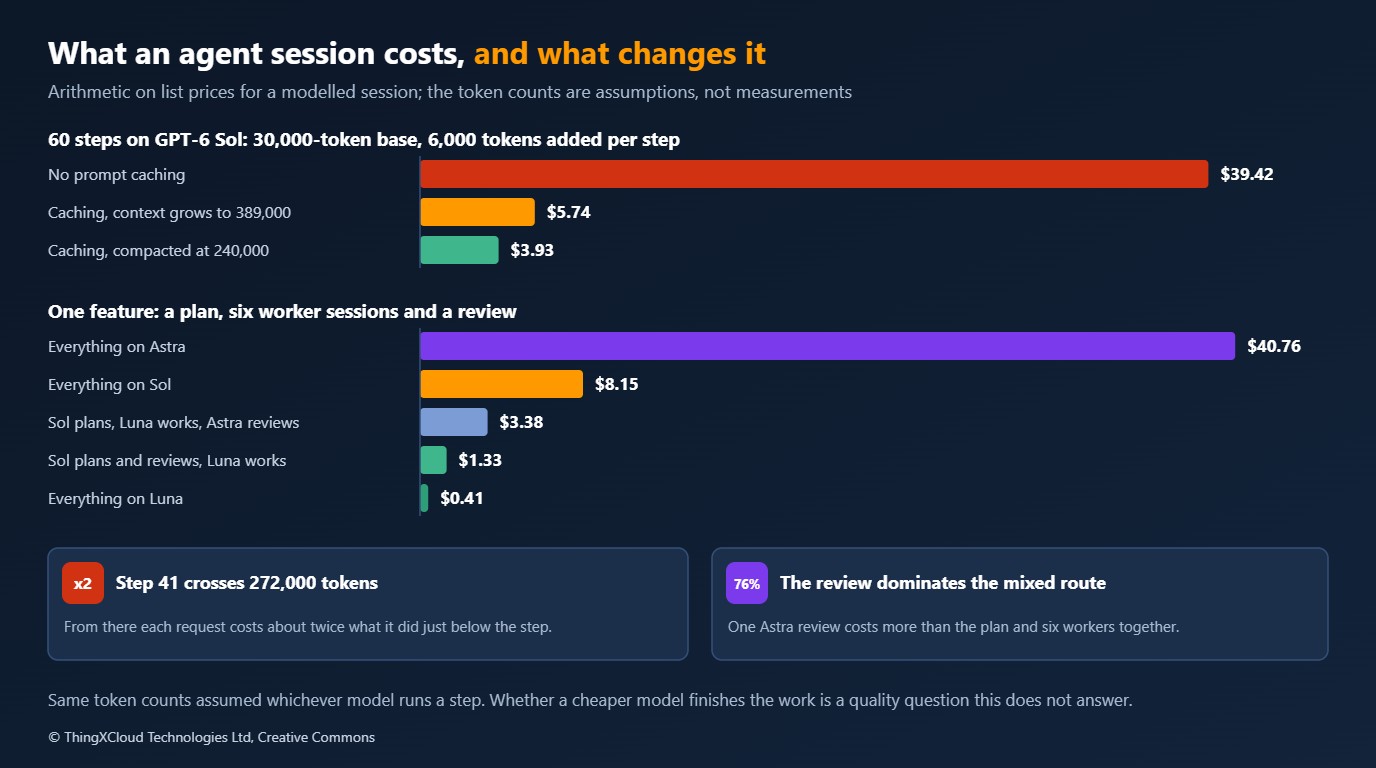
Three things stand out.
- Caching is most of the bill. The same session costs $39.42 on Sol with no caching and $5.74 with it. An agent loop is the best case for a prompt cache, because each request repeats the one before. Anything that breaks the prefix, such as a tool list that changes between steps or a timestamp near the top, moves the session back toward the first figure.
- The step arrives late and stays. The context passes 272,000 tokens at step 41, and the last twenty steps each cost about double. They are a third of the steps and well over half of the cached session’s cost.
- Compaction pays for itself. Summarising the history once the context passes 240,000 tokens keeps every request under the step. The summary is charged as a request of its own, at the uncached rate for reasons the run below makes clear, and what follows it has to be written to the cache again. The session still falls from $5.74 to $3.93.
The proportions are the same for all three models, because Sol’s prices are exactly a fifth of Astra’s and Luna’s a hundredth. The same session is $28.71 on Astra and 29 cents on Luna.
Compaction loses detail, and a session that forgets something it needed will spend steps finding it again; the sample prices the summary and not that. It also assumes steps follow each other within the cache lifetime, which starts at 30 minutes and is renewed by each read. A session left overnight starts cold and writes everything again. And it assumes the same number of tokens whichever model runs a step.
Routing one piece of work
To compare routings, take one feature as a planning session of 10 steps, six worker sessions of 25 steps and a review of 5 steps over a large diff, and price it with each part on a chosen model.
def feature(planner: str, worker: str, reviewer: str) -> float:
    return (agent_session(prices, planner, **plan).cost + 6 * agent_session(prices, worker, **work).cost
            + agent_session(prices, reviewer, **review).cost)
== 4. One piece of work split across models
everything on Astra $ 40.76
everything on Sol $ 8.15
Sol plans, Luna works, Astra reviews $ 3.38
Sol plans and reviews, Luna works $ 1.33
everything on Luna $ 0.41
ok all-Sol is a fifth of all-Astra, and all-Luna a hundredth
ok in the mixed route the Astra review is 76% of the bill, more than the planning and the six workers togetherSending the workers to Luna and keeping Sol for the plan takes the feature from $8.15 to between $1.33 and $3.38, depending on who reviews. (That $3.38 is the mixed route, not the compacted session above.) In the mixed route the Astra review is three quarters of the total. That is the line to look at before deciding that every change deserves the most capable reviewer: it may be right for a change to a payment path or a clinical rule, and wasteful for a dependency bump.
These are token prices. A worker model that takes twice as many steps, or produces a change that fails review and has to be redone, costs more than the table shows, and the engineer’s time costs more than any of it. The routing is a hypothesis to test on your own tasks, with the cheap arithmetic done first.
A Codex configuration with a model per role
Codex reads ~/.codex/config.toml. The file below gives the main session to Sol, plans at a higher reasoning effort, sends subagents to Luna, reviews with Astra, and compacts before the price step.
model = "gpt-6-sol"                     # everyday interactive and agentic coding
model_reasoning_effort = "medium"
plan_mode_reasoning_effort = "high"     # think harder while planning, before any file is touched
review_model = "gpt-6-astra"            # /review gets the most capable model

sandbox_mode = "workspace-write"
approval_policy = "on-request"
approvals_reviewer = "user"             # escalations go to a person, not to the automatic reviewer

# Compact the conversation before a request can cross 272,000 input tokens, where the price doubles.
model_auto_compact_token_limit = 240000

[agents]
default_subagent_model = "gpt-6-luna"   # spawned workers do focused, high-volume steps
default_subagent_reasoning_effort = "low"
max_concurrent_threads_per_session = 4
Profiles cover the cases where the default is wrong. In this version of the CLI a profile is a separate file beside the main one, named after the profile, and selected with --profile. Two of the three:
# ~/.codex/deep.config.toml: codex --profile deep, for hard design and debugging sessions.
model = "gpt-6-astra"
model_reasoning_effort = "high"
# ~/.codex/ci.config.toml: codex --profile ci, for unattended runs in a pipeline.
model = "gpt-6-sol"
model_reasoning_effort = "low"
sandbox_mode = "read-only"
approval_policy = "never"
service_tier = "flex"The first draft of this configuration put the profiles in [profiles.deep] tables inside config.toml. The JSON schema in the Codex repository accepts that, and validation against the schema passed. The CLI does not:
Error loading config.toml: --profile `deep` cannot be used while <temp>/home-legacy/config.toml contains legacy `profile = "deep"` or `[profiles.deep]` config; move those settings into <temp>/home-legacy/deep.config.toml and remove the legacy profile selector/table.The schema still describes the older profile tables, so a file can validate and then be refused. Validate configuration by loading it in the version of the tool you deploy. The sample keeps the schema check, records that the schema accepts the legacy form, and relies on the run below for the rest.
What Codex sends: a run against a local stand-in
To see what those settings do, the sample runs Codex CLI 0.157.1 in a pipeline with a model provider that points at a small server on the same machine. The server speaks the streaming Responses API and plays a script: run this shell command, then this one, then say done. It records every request the CLI makes and reports token usage counted from the request itself. Codex executes the scripted commands in its read-only sandbox in a throwaway repository. No model is involved, and the key the CLI is given is not a real one.
  # The example configuration from the article, plus a provider that points at the stand-in.
  { printf 'model_provider = "standin"\n'; cat "$here/../codex/config.toml"
    printf '\n[model_providers.standin]\nname = "Local stand-in"\nbase_url = "http://127.0.0.1:%s/v1"\nenv_key = "STANDIN_KEY"\nwire_api = "responses"\n' "$(cat "$work/port")"; } > "$home/config.toml"
%%{init: {'theme':'base','themeVariables':{'primaryColor':'#FFF3E0','primaryTextColor':'#232F3E','primaryBorderColor':'#FF9900','lineColor':'#232F3E','signalColor':'#0073BB','signalTextColor':'#0F172A','actorBkg':'#FFF3E0','actorBorder':'#FF9900','actorTextColor':'#232F3E','noteBkgColor':'#FFF8E7','noteBorderColor':'#FF9900','noteTextColor':'#232F3E'}}}%%
sequenceDiagram
participant C as Codex CLI
participant S as Local stand-in
participant X as Sandbox
C->>S: POST /v1/responses (stream)
S-->>C: Scripted step: run "cat NOTES.md"
C->>X: Run the command, read-only
X-->>C: Output
C->>S: Same request plus the call and its output
S-->>C: Next scripted step, or "done"Seven scenarios were run: the default configuration over six shell steps, the two profiles, a spawned subagent, a review, the same six steps with the compaction limit lowered to 20,000 tokens, and the legacy profile table. These are the six-step run’s requests. The columns are the request number, the agent, the model and effort the CLI asked for, what the stand-in replied with, the tokens taken by tool declarations, the number of items in the request, its total tokens, and whether every earlier item was sent again unchanged.
      1   main    gpt-6-sol  medium    shell           5,225            7         11,081                        -
      2   main    gpt-6-sol  medium    shell           5,225            9         11,258                     True
      3   main    gpt-6-sol  medium    shell           5,225           11         15,866                     True
      4   main    gpt-6-sol  medium    shell           5,225           13         20,476                     True
      5   main    gpt-6-sol  medium    shell           5,225           15         25,088                     True
      6   main    gpt-6-sol  medium    shell           5,225           17         29,694                     True
      7   main    gpt-6-sol  medium  message           5,225           19         34,304                     True
== checks on what the CLI sent
ok default configuration: seven requests, all to gpt-6-sol at medium effort
ok every request repeats the earlier items unchanged and adds exactly two: the call and its output
ok the tool declarations and the cache key are identical on all seven
ok responses are not stored, and tools are declared in an input item, not a top-level field
ok --profile deep sends gpt-6-astra at high effort
ok --profile ci sends gpt-6-sol at low effort on the flex tier
ok a spawned subagent's request goes to gpt-6-luna at low effort, as agents.default_subagent_model says
the subagent's first request carries 14,836 tokens before it has done anything
ok codex exec review sends gpt-6-astra, the review_model
ok with the limit at 20,000 tokens the CLI asks for a summary as soon as a reply reports more than that
ok the summary request carries no tool declarations, so it does not start like the request before it
ok the request after it is smaller than the one before the summary and begins with the same tool declarations and main instructions as the first request
before 20,476 tokens, summary request 19,988, after 11,240
after: the first 2 items (9,179 tokens) are byte-identical to the first request's; the other 6 are new or re-created
after: additional_tools:developer 5,271, message:developer 3,908, message:developer 908, message:developer 623, message:developer 108, message:user 184, message:user 67, message:user 169
ok a [profiles.deep] table in config.toml makes --profile deep fail with a message that calls it legacy
12 of 12 checks passedWhat the run shows, in the order it matters to the cost model above:
- The loop is append-only. Each request repeats every earlier item byte for byte and adds two, the tool call and its output, with the same cache key throughout. That is the shape prompt caching rewards, and it is what the session model assumed.
- The fixed overhead is about 11,000 tokens before the agent has read anything: 5,200 of tool declarations and the rest instructions and environment. That is for an empty configuration. Project instructions, skills and MCP servers add to it, and every subagent pays its own: the spawned one started at 14,836 tokens.
- The routing settings do what they say. The default sends
gpt-6-solat medium effort;--profile deepsendsgpt-6-astraat high;--profile cisends Sol at low effort on the flex tier; a subagent spawned without a model goes togpt-6-lunaat low effort;codex exec reviewgoes togpt-6-astra. - Compaction is a separate, different request. When a reply reported more tokens than the limit, the CLI sent the whole conversation again with an empty tool list and asked for a summary. Because that request does not begin like the ones before it, the prefix rule says it cannot be read from the cache, which is why the cost model charges it in full. The next request was 11,240 tokens against 20,476 before; its first two items, 9,179 tokens of tool declarations and main instructions, were identical to the first request’s, and the rest were new or re-created.
- Tools are not where older clients put them. With these models the CLI declares tools in an input item, not in the top-level
toolsfield, and offers one freeform tool that takes JavaScript and reaches the shell through it. A proxy or gateway that inspects thetoolsfield to enforce policy will see nothing.
Codex prints its own caution when it compacts:
context compacted
warning: Heads up: Long threads and multiple compactions can cause the model to be less accurate. Start a new thread when possible to keep threads small and targeted.
The limits of this run are the limits of a script. The stand-in’s token counts are its own, made with the o200k_base encoding, and stand in for what the service would report. Whether the service’s cache treats re-created items with new identifiers as a changed prefix cannot be seen from the client side. And a scripted reply says nothing about what a real model would choose to do.
Calling the models from your own code
A team building its own agent on the Responses API has the same levers, without Codex to pull them.
| Lever | What to do |
|---|---|
| Cache mode | Leave the default for loops. For one-off requests with a large prompt, use explicit mode with no breakpoint to avoid a write that will never be read |
| Prefix stability | Keep instructions and tool definitions identical between steps. Restrict tools with tool_choice instead of removing them from the list |
| Reasoning effort | On Astra, change effort mid-conversation by appending a configuration_update item instead of changing the top-level setting, which would break the cached prefix |
| Context size | Compact before 272,000 input tokens. Alert on any request that crosses it |
| Measurement | Log cached_tokens and cache_write_tokens from every response. Prompt Cache Diagnostics explains misses |
| Processing tier | Flex or Batch at half price for work nobody is waiting on; Fast at double only where latency is worth it |
Security and governance
| Concern | What applies |
|---|---|
| Capability classification | OpenAI classifies Astra as reaching its Critical cybersecurity threshold. At launch it assists with secure code review and patching and refuses to write proof-of-concept exploits (reported by DataCamp from the launch post) |
| Safety pauses | An extra safety check can pause work. In Codex the user is asked to review; in the API the task stops. A pipeline that calls Astra must treat a stopped task as an expected outcome and not retry blindly |
| Who approves | approvals_reviewer decides whether escalations go to a person or to Codex’s automatic reviewer. The sample keeps a person. Decide this per repository, and keep it a person for anything regulated |
| Sandbox | workspace-write for interactive work, read-only with no approvals for unattended runs; the run above executed its commands under read-only. Codex 0.156.0 closed several sandbox isolation gaps, which is a reason to stay current |
| Subagents | Fan-out multiplies spend and actions, and each subagent starts with its own overhead. Cap concurrent threads, and give workers the narrowest tools |
| Gateways and proxies | Codex declares tools inside the request input for these models. A control that reads only the top-level tools field no longer sees them |
| Enablement | In ChatGPT Enterprise an administrator enables the models. In Copilot Business and Enterprise, new models are on by default unless that default has been turned off; check which applies to you |
| Data residency | In Foundry, EU Data Zone deployments are priced 20% above global and US Data Zone 10%. Choose the deployment type before the model |
| Generated changes | Untrusted until reviewed and tested. A stronger review model is an extra check, not a replacement for the pull-request gates |
| Clinical and regulated code | Keep a named human reviewer on any change to decision logic. A model’s review does not discharge a clinical safety or change-control obligation |
Cost
| Item | Figure | Note |
|---|---|---|
| Sol against Astra | One fifth, on every line of the price list | Luna is one hundredth |
| A modelled 60-step session on Sol | $39.42 uncached, $5.74 cached, $3.93 cached and compacted | Assumed token counts |
| Fixed overhead per Codex session | About 11,000 tokens per request before any work; 14,800 for a subagent | Observed in the run, empty configuration |
| The price step | A request at 273,000 input tokens costs 83% more than one at 272,000 | $0.2152 against $0.1174 on Sol |
| One feature, all on Sol | $8.15 | Plan, six workers, review |
| The same, Luna workers | $1.33 with a Sol review, $3.38 with an Astra review | If the workers succeed |
| Flex or Batch | Half of the above | For unattended work |
| EU Data Zone in Foundry | 20% more | From Microsoft’s price table |
Seat-based plans hide these figures behind usage limits, and they still apply: a session that crosses the step or loses its cache uses the allowance faster.
Decision framework
| Situation | Choose | Reason |
|---|---|---|
| Default for a team starting with GPT-6 in Codex | Sol for the main session | OpenAI and GitHub both position it for agentic coding, at a fifth of Astra |
| Delegated, narrow steps: search, mechanical edits, summaries | Luna for subagents | A hundredth of the price; measure the failure rate before relying on it |
| Review of high-risk changes | Astra as review_model | An independent, stronger check where a miss is expensive |
| Review of routine changes | Sol | The Astra review was 76% of the modelled bill |
| Hard design or debugging session | Astra through a profile | Pay for it when the problem needs it, not by default |
| Unattended pipeline runs | Sol, low effort, read-only sandbox, Flex | Cheap, bounded, and nothing to approve |
| Any long session | Compaction below 272,000 tokens | The step doubles the price of everything after it. Each compaction is a full-price request, so not too low either |
| A decision that depends on quality | Your own tasks, run on each model | The published numbers are the vendor’s, on other work |
Key takeaways
- GPT-6 Astra, Sol and Luna share a 1,050,000-token window and differ in price by exactly 5 and 100 times: $10, $2 and $0.10 per million input tokens, $50, $10 and $0.50 for output.
- Two pricing rules are new. Cache writes are billed at 1.25 times the input price, and any request over 272,000 input tokens is billed at double for input and one and a half times for output, on the whole request.
- In a modelled 60-step session on Sol, caching took the cost from $39.42 to $5.74 and compaction below the step took it to $3.93. Protect the cached prefix and compact early.
- Codex has a separate setting for the main model, planning effort, subagents and review. Run against a local stand-in, CLI 0.157.1 sent Sol for the main session, Luna for a spawned subagent and Astra for a review, and refused a profile written the older way that the schema still accepts.
- Routing workers to Luna cut the modelled cost of a feature by 59 to 84%, and one Astra review cost more than everything else together. Decide which changes earn that review.
If you have run the same tasks through Sol and Luna as Codex subagents, I would like to know how often Luna’s work survived review. Leave a comment.
The facts in the tables were read from OpenAI’s API changelog and model pages, Microsoft’s Foundry announcement, GitHub’s changelog, the Codex release notes for 0.153.0 and 0.156.0 and Microsoft’s Codex documentation; benchmark and safety statements attributed to OpenAI’s launch posts were read in press coverage, linked beside them, because the posts themselves could not be retrieved. Everything else ran in GitHub Actions. The cost model passed 21 checks against hand calculation and the configuration schema at tag rust-v0.157.1. Codex CLI 0.157.1, installed from npm, was then run in seven scenarios against a local stand-in for the Responses API, and 12 checks on the recorded requests passed: models, efforts and service tier per setting, the append-only loop, the subagent, the review, compaction at a lowered limit and the refusal of the legacy profile table. The stand-in plays a script and counts tokens itself; the scripted commands were run by Codex in its read-only sandbox in a throwaway repository. Not run: any request to a GPT-6 model, the interactive interface, plan mode, MCP servers, and the profiles’ behaviour beyond the first requests. The session shapes in the cost model are assumptions. Nothing here measures code quality, task success, latency or the service’s real cache behaviour. The run is here.
The price list, the cost model, the Codex configuration, the stand-in server and the harness that drives the CLI are in gpt6-codex-model-routing in the samples repository. ./ci.sh out runs everything with Python, Node.js and no account; the harness installs the Codex CLI from npm and gives it a provider that exists only on your machine. Change the session shapes in tests/run.py to your own numbers before drawing conclusions.
Glossary
- Codex— OpenAI’s coding agent: a CLI, an IDE extension, a desktop app and a cloud service that run a model in a loop with tools.
- Agent loop— Repeated requests in which the model calls a tool, receives the result and decides the next step, carrying the conversation each time.
- Subagent— A separate agent session started by the main one to do a delegated part of the work.
- Reasoning effort— A setting that controls how much the model reasons before answering; more effort means more output tokens.
- Prompt cache— The provider’s store of recently processed prompt prefixes. Reading from it is cheap; on these models, writing to it costs more than ordinary input.
- Cache breakpoint— The point in a prompt up to which the content is written to, or read from, the cache.
- Compaction— Replacing the earlier part of a long conversation with a summary so that it fits and costs less.
- Long-context pricing— Higher rates applied to a whole request when its input exceeds a threshold, here 272,000 tokens.
- Profile— A named set of Codex settings selected for one run with a command-line option.
- Flex and Batch— Slower processing options at half the standard price.
- OSWorld, Terminal-Bench, DeepSWE— Benchmarks of computer use, of agent work in a terminal and of software-engineering tasks.
References & Further Reading
- → OpenAI API changelog— Release dates for GPT-5.6, GPT-6 Astra, Sol and Luna, and the caching features
- → GPT-6 Astra model page— Limits, prices, long-context rule, reasoning effort
- → GPT-6 Sol model page— The same for Sol
- → GPT-6 Luna model page— The same for Luna
- → Prompt caching guide— Cache writes and reads, breakpoints, explicit mode, lifetime
- → Announcing GPT-6 Sol and GPT-6 Luna in the API, Codex and ChatGPT— OpenAI developer community, 22 September 2026
- → GPT-6 Astra, Sol and Luna for production agents in Microsoft Foundry— Microsoft, 22 September 2026: availability, price table, deployment types
- → OpenAI’s GPT-6 Sol and GPT-6 Luna now available— GitHub changelog: Copilot plans, surfaces and policy
- → Codex CLI 0.156.0 release notes— Reasoning effort, subagents, usage dashboard, sandbox fixes
- → Codex CLI 0.153.0 release notes— Experimental context management
- → Codex configuration schema, 0.157.1— The file the example configuration was validated against
- → @openai/codex on npm— The CLI package the harness installs, at version 0.157.1
- → Codex with Azure OpenAI in Microsoft Foundry— Microsoft: provider configuration and validated CLI versions
- → OpenAI upgrading ChatGPT and Codex with two more GPT-6 models— 9to5Mac: availability and OpenAI’s reported benchmark figures
- → GPT-6 Astra: features, benchmarks and pricing— DataCamp: OpenAI’s reported benchmarks and safeguards for Astra
- → Sample code for this article— Price list, cost model, Codex configuration, stand-in and harness
Discover more from C4: Container, Code, Cloud & Context
Subscribe to get the latest posts sent to your email.