MCP connects an agent to its tools; A2A connects an agent to another agent. This article wires a .NET Microsoft Agent Framework coordinator on Azure to a Python agent and MCP tool server laid out for Amazon Bedrock AgentCore Runtime, and reports what broke: A2A 0.3 versus 1.0 version skew, identity across the cloud boundary, and task lifecycle handling.
Read more →Tag: C#
One Abstraction, Two Clouds: Microsoft.Extensions.AI over Azure OpenAI and Amazon Bedrock
Microsoft.Extensions.AI gives .NET services one interface over Azure OpenAI and Amazon Bedrock. This article builds a two-provider ASP.NET Core service with per-provider telemetry, caching, token metering, tool calling and failover, and is clear about where the abstraction stops: model identity, errors, content safety and model behaviour remain provider-specific.
Read more →SQL Server 2025 for Architects: The Vector Type and Native JSON
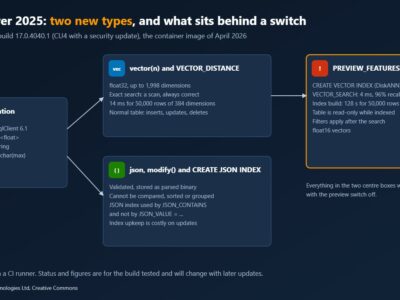
What the SQL Server 2025 vector and json types do when you run them: exact and approximate search, what still needs the preview switch, what an index costs on writes, and when one engine is enough. Every result comes from the container image in a CI pipeline.
Read more →.NET 10 on AWS Lambda: Managed Runtime, Native AOT and SnapStart
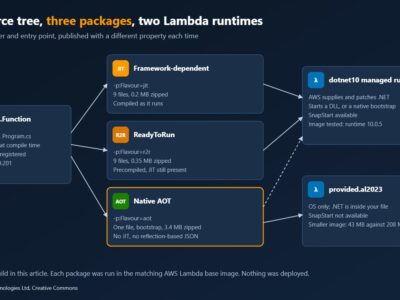
One .NET 10 function built three ways from one source tree and run in the AWS Lambda base images under the Runtime Interface Emulator: what each build costs at start-up, what breaks under Native AOT, what SnapStart asks of your code, and how to choose.
Read more →SMART Backend Services: System-to-System FHIR Authorization in .NET 10
SMART Backend Services end to end in .NET 10: a client that signs a one-time assertion, a token endpoint that checks it, and a gateway that enforces system scopes in front of HAPI FHIR, including _revinclude, chained search, transactions and paging links. Tested with 22 token requests that must be refused and a second client in Python.
Read more →HL7 v2 ADT to FHIR in .NET 10: Synthetic Messages, Validated Output
A converter for six ADT trigger events in .NET 10 with no package dependencies: a v2 reader, a mapper that reads only the message, and an applier that handles duplicates, out-of-order events, sparse updates and merges. Twelve synthetic messages, applied to a FHIR R4 server, with every Bundle put through the HL7 validator.
Read more →